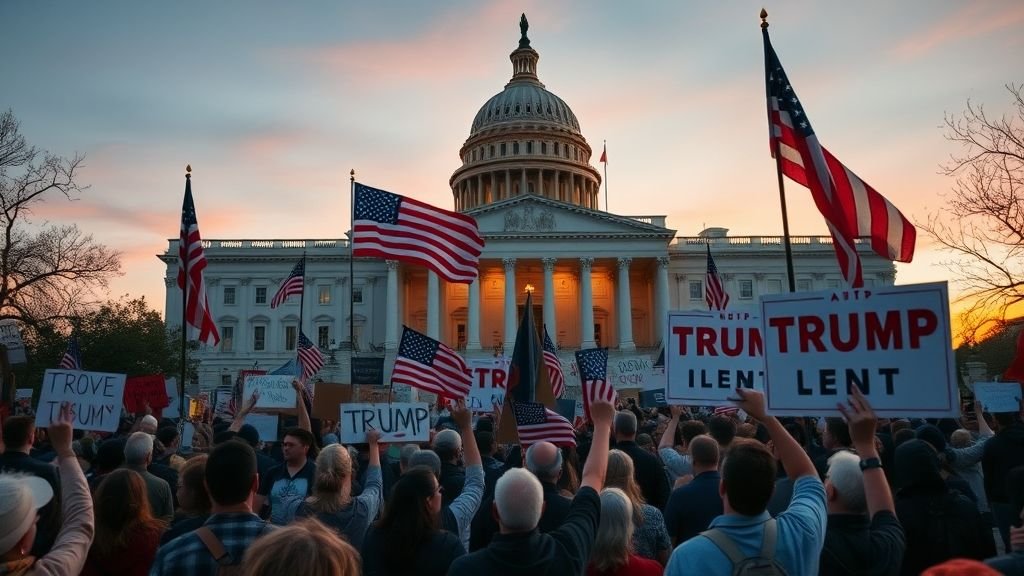
The phrase “Trump protests” only scratches the surface of what’s unfolding across the United States. In mid-October 2025, a massive, coordinated wave of demonstrations branded “No Kings” swept all 50 states — critics say against the second term of Donald Trump and his administration’s perceived drift toward authoritarianism.
In parallel, Trump took to his own platform, Truth Social, and posted an AI-generated video in which he casts himself as “King Trump” flying a fighter jet and pouring brown sludge or “liquid” on protesters. The juxtaposition of millions marching and a president mocking dissent via deep-fake imagery turned this episode into a pivotal moment in the narrative of Trump protests.
This article unpacks how we got here — the motivations behind the protests, the trigger of the video, where things stand now — and why this matters not just for the U.S., but for the broader story of democracy and protest movements in the digital age.
What triggered the latest wave of Trump protests?
1. The “No Kings”-Movement
In June 2025, an initial national rollout of the “No Kings” protests occurred, with organisers estimating 4–6 million people across 2,100+ towns and cities. On 18 October 2025, the second major wave built on that foundation: organisers claim nearly 7 million people participated in over 2,700 events in all 50 states.
The movement’s name is deliberate — “No Thrones. No Crowns. No Kings.” — reflecting a rejection of what participants view as executive overreach by Trump.
2. Economic & policy frustrations
Though the protests are framed in terms of democratic safeguards, they are grounded in concrete policy discontent. Some of the key grievances include:
- The cost of living and inflation: Many Americans report rising prices and feel less secure economically under the Trump administration.
- Immigration and crackdown tactics: The use of federal agents, the militarisation of city law-enforcement responses, and large-scale deportations triggered alarm.
- Foreign policy concerns: Observers point to perceived instability or mis-steps in Trump’s handling of alliances and global issues.
3. Perceived authoritarian tone and tech-enabled messaging
The tone of governance, the deployment of National Guard or federal agents in cities like Portland, and a willingness to use newly emerging digital/AI media have all alarmed critics as signals of democratic backsliding.
The AI Video Flashpoint — A Turning Point in the Trump Protests
One of the most striking moments came shortly after the October protest wave. President Trump posted an AI-generated video on Truth Social in which he appears wearing a crown, flying a jet marked “KING TRUMP” and dumping brown sludge on protesters.
Why it matters
- Symbolism: The video inverted the protest’s slogan (“No Crowns”) by depicting Trump as a monarch. That imagery resonated widely and became a lightning rod for conversation about power and dissent.
- Digital escalation: It underscored how political messaging is now merging with AI/deep-fake aesthetics — raising questions about propaganda, mockery, and digital democracy.
- Feedback loop: Protesters had taken to the streets; the video arguably amplified both the protests and the perception of a president antagonistic toward dissent.
The administration’s stance
Sources say Trump downplayed the protests, calling them unrepresentative. Simultaneously, statements floated the possibility of invoking the Insurrection Act, a dramatic suggestion of federal force against domestic unrest.
Where things stand now — Key implications of the Trump protests
A. Record turnout, heightened awareness
The October wave of protests may qualify as one of the largest single-day demonstrations in U.S. history — organisers cite nearly 7 million participants. That scale lends significant weight to the underlying message: a substantial segment of the public feels deeply uneasy about Trump’s trajectory.
B. Polarisation and the online-offline interplay
The combination of mass street protests and digitally mediated provocations (like the AI video) reflects a hybrid front. Trump’s base often meets such stunts with enthusiasm; opponents view them as symptomatic of a deeper erosion of norms. The result: heightened polarisation with each side more entrenched.
C. Democratic institutions under stress
Protesters cite deployment of troops, federal overrides of local jurisdictions, and a style of leadership they consider monarchical. While Trump insists “I’m not a king,” his messaging and tactics feed the narrative being protested.
D. Global ripple effects
What happens in the U.S. often reverberates internationally. Large-scale domestic unrest under a major power raises questions for democracies and autocracies alike: about civil liberties, the role of protest, and digital manipulation of political communication.
What to watch next
- Will the protest momentum sustain? This may depend on whether organisations behind “No Kings” can convert momentary energy into longer-term mobilisation.
- How will the administration respond? A shift toward more forceful federal intervention, or more conciliatory tone, could reshape the trajectory.
- What role will digital media & AI play? The viral video points toward a new frontier in political conflict: where visuals, deep-fakes, and social platforms co-shape protests and power.
- Economic conditions. If economic dissatisfaction deepens (inflation, jobs, cost of living), the basis for protest could widen beyond political ideology.
Conclusion
The “Trump protests” of October 2025 are about far more than politics as usual. They mark a turning point where mass street mobilisation, digital spectacle, and constitutional anxieties converge. From the sprawling “No Kings” rallies across every U.S. state to the viral AI video posted on Truth Social, the drama unfolding frames a question: how will the U.S. balance popular dissent, executive power, and democratic norms in an era of new media and hyper-polarisation?
If nothing else, these protests suggest Americans are willing to take to the streets — and to their screens — to contest not just policy, but the very shape of power. That is the real story behind the wave of Trump protests.
Sources: The Guardians, The Independent
For more on current events, check out our full coverage of the why the US should Ban the Muslim Brotherhood and stay updated on the latest developments.