
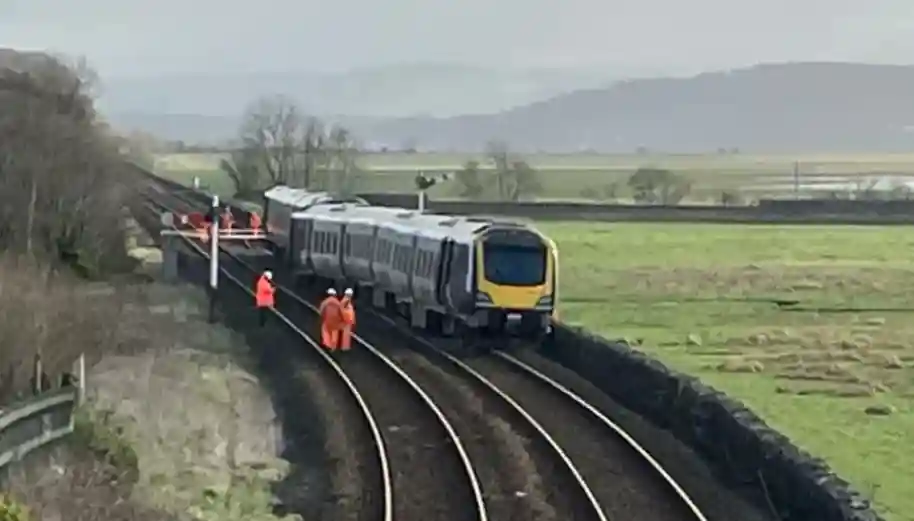
A major Cumbria train derailment early Monday morning caused significant disruption across one of the UK’s busiest rail corridors. The incident occurred near the village of Shap in Cumbria, where an Avanti West Coast service traveling between London and Glasgow came off the tracks. Several carriages were affected, prompting the declaration of a major incident by local authorities.
Emergency services, including paramedics, police, and fire crews, responded swiftly to the scene. Rail passengers were safely evacuated from the train, and first responders confirmed that no injuries were reported among passengers or staff. The swift response from train operators and local emergency teams helped prevent further harm and ensured that all onboard were assisted promptly.
How the Incident Unfolded
According to early reports, the train derailed shortly before dawn on a section of track near Shap Summit, an area known for steep gradients and challenging weather conditions. Witnesses described feeling a sudden jolt followed by a grinding noise before the train came to a halt. The carriages tilted but remained upright, preventing a more severe outcome.
Rail operator Avanti West Coast issued a statement expressing relief that no one was hurt and apologizing to passengers for the disruption. The company is cooperating closely with Network Rail and the Rail Accident Investigation Branch (RAIB) to determine what caused the Cumbria train derailment.
Widespread Travel Disruption
The derailment forced the closure of all rail lines between Carlisle and Preston, effectively severing a key route between England and Scotland. Trains have been cancelled or delayed, and National Rail has advised passengers not to travel north of Preston unless absolutely necessary.
Replacement bus services have been introduced, but travel times are expected to be significantly longer. Some travelers stranded overnight were provided accommodation and refreshments by rail staff. Transport authorities have described the incident as one of the most serious disruptions on the West Coast Main Line in recent years.
Possible Causes Under Investigation
While the precise cause of the Cumbria train derailment has not yet been identified, investigators are examining multiple possibilities, including track defects, wheel issues, and weather-related factors. Heavy rainfall in the area over the weekend may have weakened sections of the track bed, increasing the risk of slippage. Engineers from Network Rail are carrying out structural assessments and repairs to ensure the line’s integrity before reopening.
Experts say that such derailments, though rare, can occur due to a combination of factors such as maintenance delays, track instability, or signal malfunctions. Authorities have confirmed that the investigation could take several days to complete, with safety remaining the top priority.
Impact on Commuters and Freight
The closure of this vital corridor has affected thousands of commuters and disrupted the movement of freight trains between the north and south. Businesses dependent on just-in-time deliveries have reported logistical challenges. Transport analysts warn that even after services resume, delays and speed restrictions may continue for several days as safety inspections progress.
Avanti West Coast has announced full refunds and flexible ticket policies for affected passengers. Those with tickets for today or tomorrow can use them later in the week without penalty. Network Rail and Avanti teams are working around the clock to restore normal operations.
Reactions and Safety Assurances
Local MPs and community leaders have praised the professionalism of emergency responders and rail staff for handling the situation efficiently. Transport Secretary officials said they are closely monitoring the situation and will ensure a thorough investigation into the cause of the Cumbria train derailment.
Passengers who were onboard have shared accounts of shock and relief. “There was a loud bang, and the train shook, but the crew kept everyone calm,” one traveler told local media. “It could have been so much worse.”
Rail experts emphasize that Britain’s railway system remains one of the safest in Europe, and incidents of this nature are exceptionally rare. However, the Cumbria derailment highlights the importance of regular maintenance and infrastructure resilience, especially in areas prone to harsh weather.
What Happens Next
Engineers are now working to lift the derailed carriages back onto the track using specialized cranes. Once debris is cleared and the damaged track repaired, the Rail Accident Investigation Branch will release its preliminary findings. Authorities hope to reopen the line gradually, possibly within the next 24 to 48 hours, depending on safety clearance.
In the meantime, passengers are urged to check updates on National Rail Enquiries and Avanti West Coast’s official channels before traveling. Rail operators have apologized for the inconvenience and pledged to keep passengers informed of progress.
As investigations continue, the Cumbria train derailment serves as a reminder of the complex logistics and safety measures required to keep Britain’s railways running smoothly. While the incident caused major disruption, the absence of casualties stands as a testament to the effectiveness of modern safety systems and the quick coordination of emergency teams.
Source: The Guardian
For more on current events, check out our full coverage of the Lenskart IPO 2025 and stay updated on the latest developments.