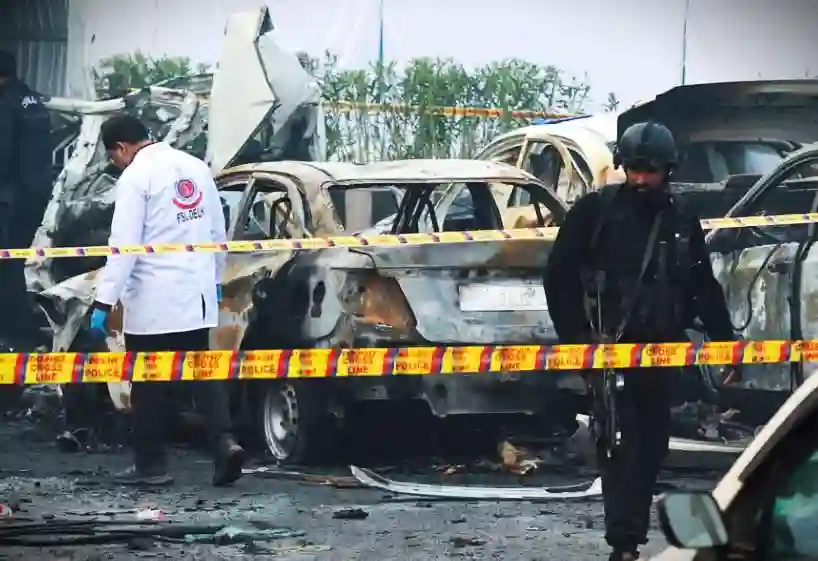
On 11 November 2025, the heart of Pakistan’s capital shook after the tragic Islamabad suicide bombing. A suicide attacker blew himself up outside the district judicial complex in Islamabad’s G-11 sector. The resulting explosion, widely reported as the Islamabad court blast, claimed at least 12 lives and left dozens wounded.
The Blast and the Immediate Fallout
At around 12:39 p.m., the assailant tried to breach the court gates. When he failed to enter, he detonated his explosives near a parked police vehicle. Witnesses described chaos everywhere. Cars burned, bodies lay near the gates, and panic spread across the judicial precinct. Victims included lawyers, litigants, bystanders, and security staff. Soon after, emergency services arrived as thick smoke rose above Islamabad’s skyline.
Blame, Accusations and the Bigger Picture
Within hours, the Islamabad court blast turned from a tragedy into a diplomatic flashpoint. The Pakistani government quickly blamed “foreign-backed militants,” claiming the attacker had handlers in Afghanistan. Meanwhile, India rejected the allegations as “baseless and unfounded.” It warned that Islamabad should not turn terror attacks into tools of political rivalry. Consequently, analysts believe the bombing sent a clear signal. It showed that the heart of Pakistan’s government remains vulnerable and that fragile regional cease-fires may now be breaking apart.
Regional Tensions and the Shadow of War
The fallout from the Islamabad court blast has already led to heightened security alerts, particularly along the Pakistan-Afghanistan border. With both governments exchanging accusations, the diplomatic war is underway.
Pakistan’s Defence Minister declared the country was in a “state of war” following the attack; such language underscores how this incident has evolved into more than just a terror strike—it’s now a geopolitical flash-point.
Why This Attack Matters
- It was the deadliest attack in Islamabad in nearly a decade, therefore striking at a symbol of law and order.
- The target—a court complex—therefore signifies the militants’ direct challenge to state authority and the rule of law.
- The rapid diplomatic tit-for-tat clearly shows how terror can not only transcend the immediate tragedy but also ripple outward into broader international relations.
- For the region, the Islamabad court blast may therefore mark a crucial turning point, as it is a provocation that could shift security dynamics and consequently force both states to respond more aggressively.
What to Watch Next
- The investigation now focuses on who funded and directed the attack; moreover, officials are examining whether external state actors were involved or if this was purely a militant operation.
- Pakistan’s next moves: military operations along its borders, changes in internal security policy, and whether diplomatic initiatives will follow.
- How India and Afghanistan respond, however, remains crucial. Will the allegations further deepen their ties, or will there instead be counter-accusations and possible international mediation?
- The effect on civilians: whether fear spreads, court operations slow down, and whether this becomes a prolonged security crisis rather than an isolated incident.
Source: Washington Post
For more on current events, check out our full coverage of the Loomer Payment Controversy and stay updated on the latest developments.