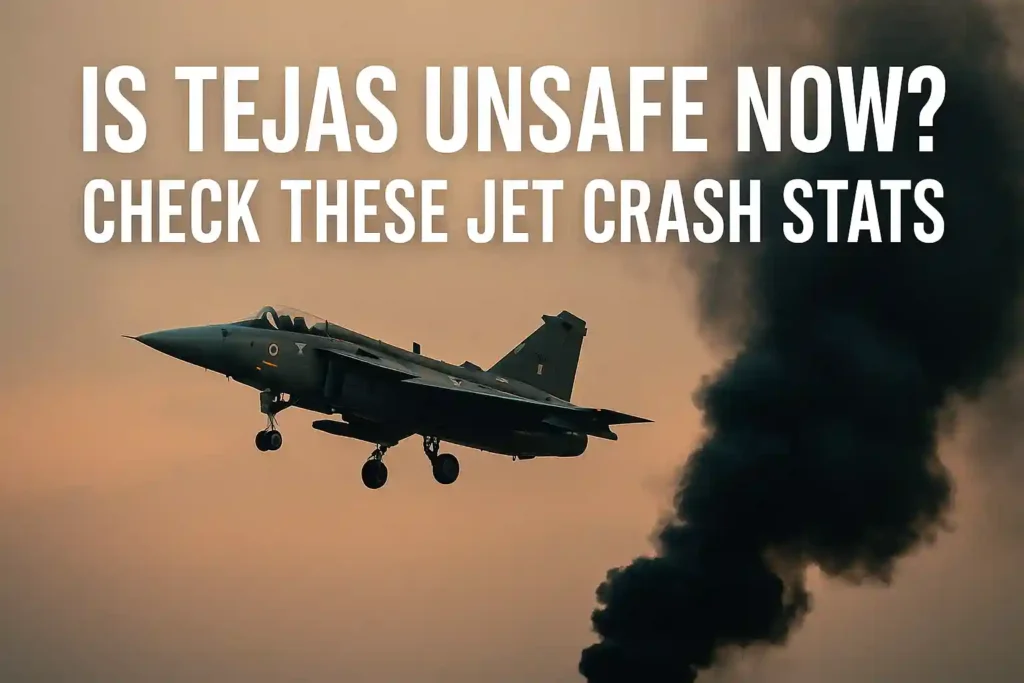
The recent Tejas incident has sparked a wave of questions about safety, performance, and reliability. To understand the situation objectively, it is important to examine global fighter jet crash data rather than judge any aircraft based on a single event. Modern military aviation operates in high-risk environments, and accidents occur across many platforms, irrespective of manufacturer or country.
A Global Look at Fighter Jet Crash Trends
Every modern fighter jet—whether Western, Asian, or Russian—has experienced some level of operational loss. These incidents occur during training sorties, air demonstrations, high-G maneuvers, and, in some cases, during combat operations. Factors such as pilot error, mechanical failures, weather challenges, or maintenance issues all play a role in global aviation incidents.
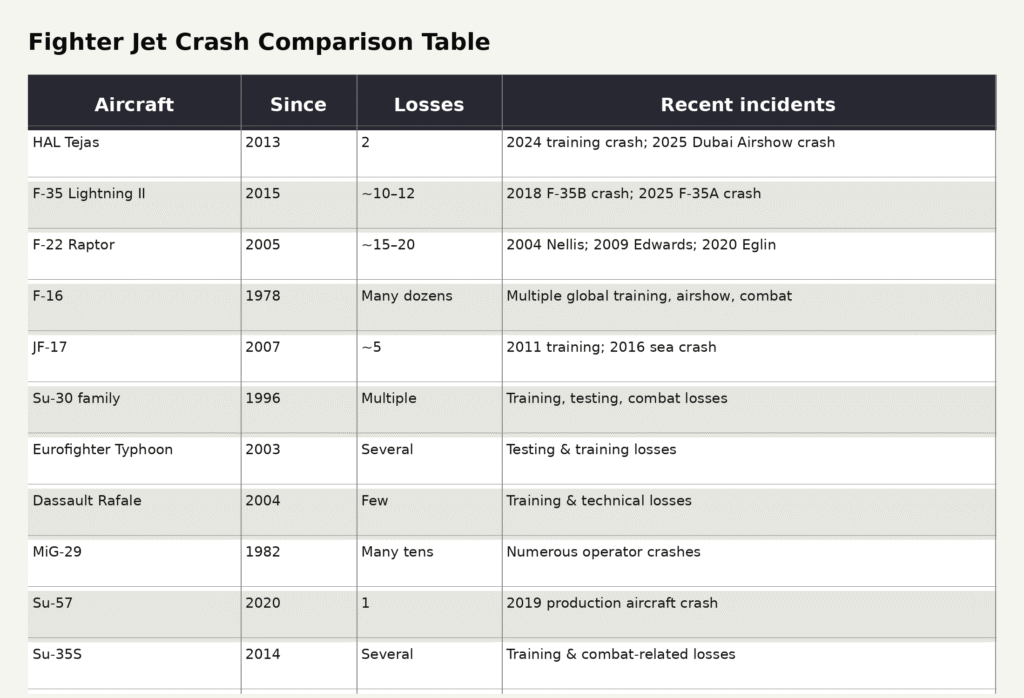
When compared globally, the Tejas has recorded two hull-losses since becoming operational in 2013. In contrast, other modern fighter jets with longer or broader service histories show higher numbers of losses. These figures often reflect usage volume, mission intensity, maturity of fleets, and decades of operational exposure rather than inherent design flaws.
How Tejas Compares With Other Fighters
Modern platforms such as the F-35, F-22, JF-17, Su-30 family, Eurofighter Typhoon, Rafale, Su-57, and Su-35S have all faced documented accidents. Many of these aircraft have been in service for much longer or are operated by multiple air forces worldwide, increasing their cumulative exposure and risk of accidents. Understanding these numbers helps highlight that Tejas is not an exception but part of a global pattern seen across fighter aviation.
Why Operational Context Matters in Fighter Jet Crash Analysis
Aircraft operating in demanding flight regimes—such as low-altitude drills, high-angle maneuvers, or airshow demonstrations—face higher accident probabilities. A fighter jet crash does not immediately indicate a systemic production issue. Instead, investigations typically look at flight data, training conditions, environmental factors, and maintenance logs to identify accurate causes.
Why Comparative Data Is Important
Looking at global records provides a clearer and more neutral perspective. Newer jets like the Tejas and KF-21 have limited operational histories, while older platforms like the F-16 or MiG-29 naturally accumulate more incidents over decades of service. This makes comparative analysis essential to avoid misleading conclusions based on isolated events.
Conclusion
No modern fighter jet is completely immune to accidents. The Tejas crash, while unfortunate, fits into a broader global pattern seen in military aviation. A neutral assessment based on fighter jet crash data shows that such incidents occur across many aircraft programs. Understanding these patterns helps frame the discussion around safety in a factual, balanced, and global context.
Source: F-16 Net, Aviation Safety Network, ANADOLU AGENCY
For more on current events, check out our full coverage of the What Happened During the HAL Tejas Crash in Dubai and stay updated on the latest developments.