
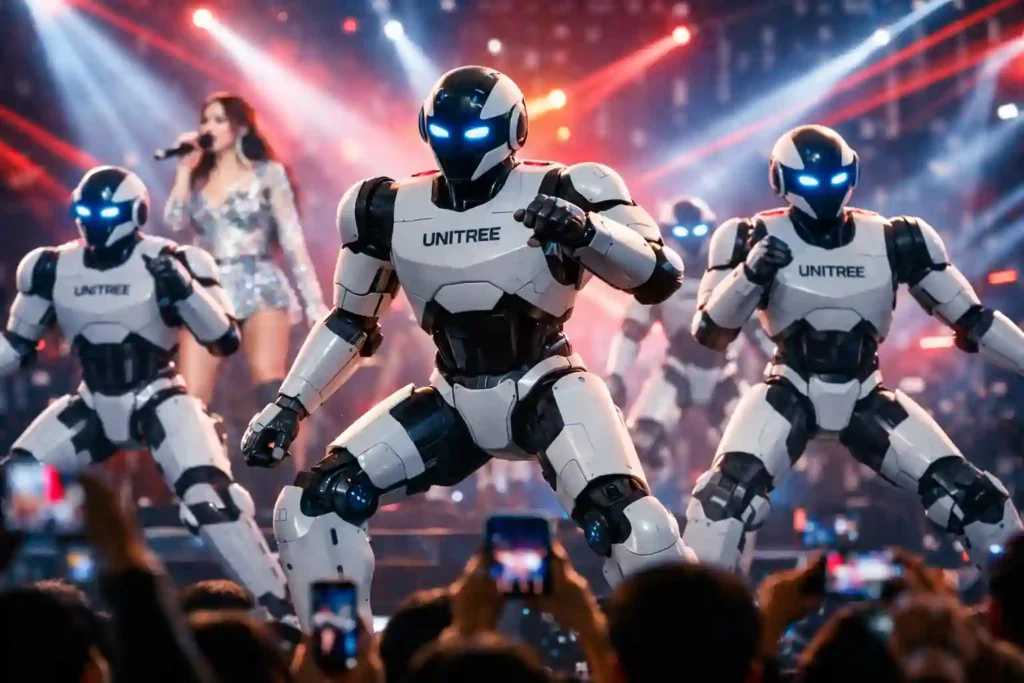
Humanoid robots are no longer confined to research labs or controlled demos. Recently, Unitree humanoid robots were seen performing as synchronized backup dancers during a live concert in China. The moment quickly went viral, raising an important question: why is entertainment becoming the entry point for humanoid robots?
The answer lies primarily in visibility, public acceptance, and practical deployment. In particular, entertainment offers a highly public-facing environment where robots can perform structured tasks, while avoiding the high risks commonly associated with healthcare, transportation, or industrial automation.
Why Entertainment Is the Lowest-Risk Entry for Unitree Humanoid Robots
For Unitree humanoid robots, therefore, concerts and stage performances provide an ideal proving ground. In this setting, precision movement, timing, and coordination certainly matter; however, absolute perfection is not required. Instead, audiences largely expect novelty and visual impact rather than flawlessness.
Unlike factories or hospitals, entertainment environments:
- Tolerate minor errors
- Require no complex decision-making
- Involve limited safety liabilities
- Deliver immediate public exposure
This makes the entertainment industry a natural starting point for Unitree humanoid robots to demonstrate real-world capability.
Why Unitree Humanoid Robots Fit This Moment
Unitree designs its humanoid robots for dynamic motion, balance, and repeatable choreography. As a result, these strengths work especially well in live performances, where synchronized movement matters more than advanced cognition.
Additionally, entertainment allows companies like Unitree to:
- Showcase robotic agility in real time
- Build public trust through familiarity
- Attract commercial partners and sponsors
- Gather performance data at scale
For more technical details on their humanoid platforms, Unitree’s official robotics page provides background on their development focus.
Public Acceptance Comes Before Industrial Adoption
Historically, new technologies often enter society through entertainment first. Computer graphics thrived in movies before engineering. Drones gained acceptance through aerial shows before logistics. Similarly, Unitree humanoid robots performing on stage help normalize human-robot interaction.
Once people stop seeing robots as threatening or strange, adoption in more serious sectors becomes easier.
What This Means for the Future of Humanoid Robots
The rise of Unitree humanoid robots in entertainment suggests a clear roadmap:
- Visibility through performances
- Acceptance through familiarity
- Expansion into service, retail, and public spaces
Entertainment is not the final destination—but it is likely the first sustainable business model for humanoid robotics.