
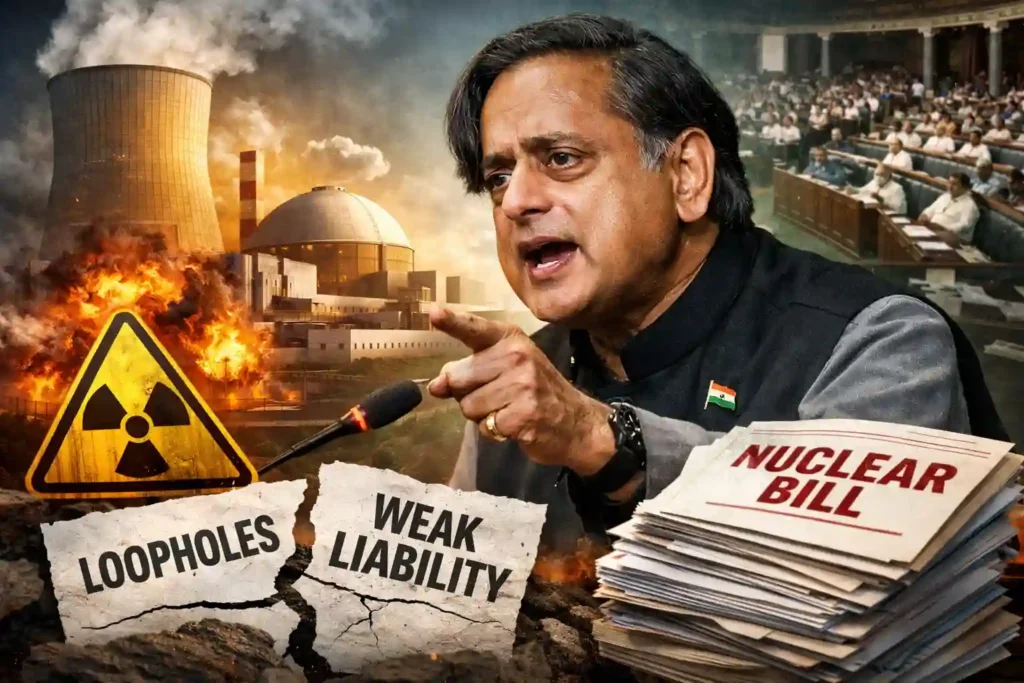
The debate around the India nuclear energy bill intensified in Parliament after a forceful speech by Shashi Tharoor, who warned that the proposed legislation could weaken safety, accountability, and public trust in India’s nuclear framework.
Speaking during the parliamentary discussion, Tharoor argued that although nuclear power may serve as a strategic necessity, lawmakers must draft the law with precision, transparency, and a people-centric approach. Instead of meeting those standards, he said the current bill contains structural flaws so serious that they require a complete reworking rather than minor amendments.
The speech was delivered during a Lok Sabha debate and broadcast by Sansad TV, the official parliamentary channel, with the full remarks available via its public video archive.
A Bill With Power, But Little Precision
One of Tharoor’s sharpest criticisms was directed at the drafting quality of the India nuclear energy bill. He remarked that India has mastered nuclear fusion and fission, but not legislative precision. According to him, the bill relies heavily on vague language, broad exemptions, and executive discretion.
Tharoor warned that ambiguity in nuclear regulation is not a minor technical issue. In a sector where even small lapses can have catastrophic consequences, unclear laws increase systemic risk rather than containing it.
Nuclear Safety and Environmental Risks
While making it clear that he does not oppose nuclear energy itself, Tharoor challenged the bill’s portrayal of nuclear power as a “clean and abundant” energy source. He pointed out that the entire nuclear fuel cycle — from mining to waste disposal — creates long-term environmental and health risks that the legislation fails to acknowledge honestly.
Radioactive leaks, nuclear waste that remains hazardous for thousands of years, and the possibility of large-scale accidents were concerns he said the bill downplays. According to him, the India nuclear energy bill fails to honestly communicate these risks to the public.
Private Control and Profit-Driven Risk
A major concern raised in the speech was the bill’s provision allowing private entities to operate across multiple stages of the nuclear fuel cycle. Tharoor argued that concentrating mining, reactor operation, and waste handling under a single private operator increases risk rather than reducing it.
He warned that when profit becomes the primary motive in such a sensitive sector, safety checks could be compromised at every stage. In his view, the India nuclear energy bill opens the door to excessive privatisation without building equally strong accountability safeguards.
Weak Liability and Public Burden
Tharoor strongly criticised the proposed liability cap for nuclear accidents, calling it outdated and grossly inadequate. He noted that the cap has not been revised in years, despite inflation and lessons learned from disasters such as Fukushima.
He also objected to provisions that shift the financial burden of catastrophic nuclear accidents onto taxpayers, while equipment suppliers and private operators face limited exposure. According to him, the state ends up underwriting risk, while private companies retain profits.
Justice Delayed, Justice Denied
Another key objection was the strict limitation period for filing compensation claims. Tharoor argued that radiation-related illnesses often emerge decades after exposure, making short legal deadlines unjust.
Under the India nuclear energy bill, many victims — including children exposed to radiation — could lose the right to seek compensation before symptoms even appear. He described this as a legal framework designed to limit liability rather than protect citizens.
Oversight Without Independence
Tharoor also criticised the regulatory structure proposed in the bill, stating that it keeps nuclear oversight firmly under central government control. He argued that a government promoting nuclear expansion cannot simultaneously act as a fully independent regulator.
He called for a genuinely autonomous, multi-stakeholder regulatory authority, insulated from political and corporate influence, to restore public confidence in nuclear governance.
Why Tharoor Says the Bill Needs Reworking
In conclusion, Tharoor stated that the India nuclear energy bill, in its current form, weakens democratic oversight, restricts access to justice, and prioritises administrative convenience over public welfare.
Rather than rejecting nuclear energy outright, his opposition centres on the need for stronger safeguards, clearer accountability, and meaningful public participation. Without these, he warned, the bill risks creating long-term consequences that India may struggle to contain.