
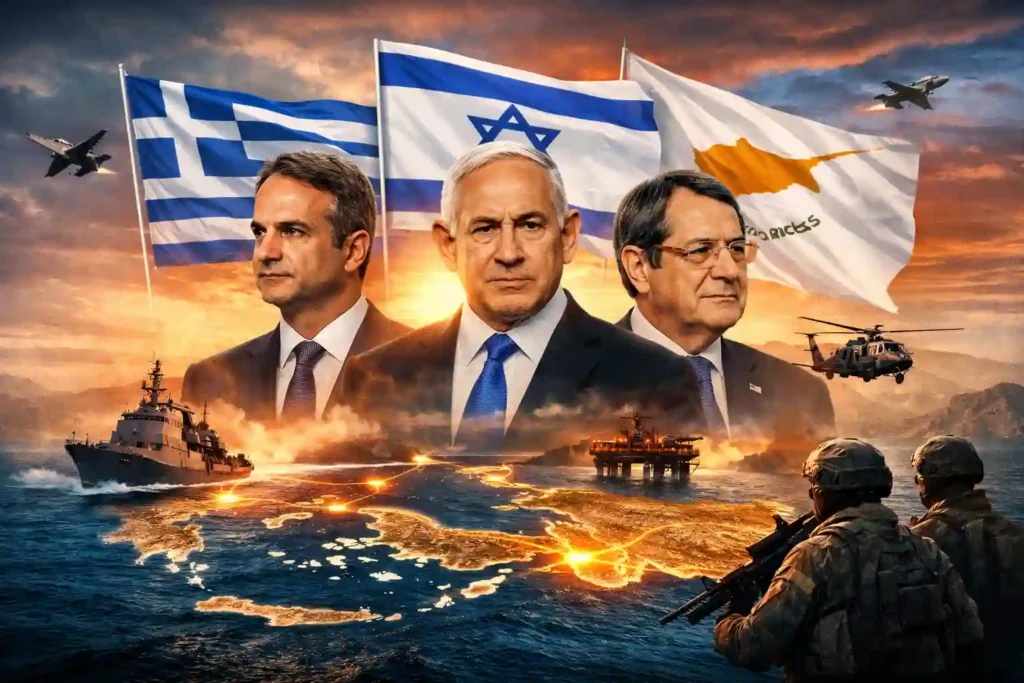
The latest Greece Israel Cyprus meeting comes at a moment of heightened geopolitical tension in the Eastern Mediterranean. While Greece, Israel, and Cyprus have cooperated for years, the current regional environment has given new urgency to their trilateral dialogue. Leaders focused on sovereignty, stability, and coordination in a region shaped by energy competition, maritime disputes, and shifting power dynamics.
Speaking after the meeting, Israeli Prime Minister Benjamin Netanyahu emphasized that nations which achieved independence through sacrifice will not accept renewed domination or external pressure. His remarks reflected a broader consensus shared during the Greece Israel Cyprus meeting — that regional cooperation is essential to deter threats and protect national interests.
An official spokesperson statement released by the Prime Minister’s Office of Israel following the Greece Israel Cyprus meeting outlined Israel’s position on regional security, sovereignty, and trilateral cooperation in the Eastern Mediterranean.
Security and Energy Outcomes of the Greece Israel Cyprus Meeting
A central outcome of the Greece-Israel-Cyprus meeting was renewed emphasis on security coordination. The three countries highlighted cooperation in maritime security, intelligence sharing, and joint military exercises, all aimed at maintaining stability in the Eastern Mediterranean.
Energy security also featured prominently. Greece and Cyprus act as key links between Eastern Mediterranean gas resources and European markets. Israel, meanwhile, remains a major energy producer. Through the Greece–Israel–Cyprus meeting framework, the countries aim to secure energy routes, protect offshore infrastructure, and limit vulnerability to regional disruptions.
A Unified Message on Sovereignty and Stability
Beyond technical cooperation, the Greece-Israel-Cyprus meeting sent a clear political message. Without naming specific actors, the leaders rejected revisionist ambitions and attempts to redraw borders or impose dominance through force. The emphasis on sovereignty, international law, and self-defense underscored the strategic alignment among the three nations.
Importantly, the meeting further reinforced that this trilateral partnership is not merely symbolic. Instead, regular summits, ongoing ministerial coordination, and expanding areas of cooperation together signal a long-term commitment to regional stability.