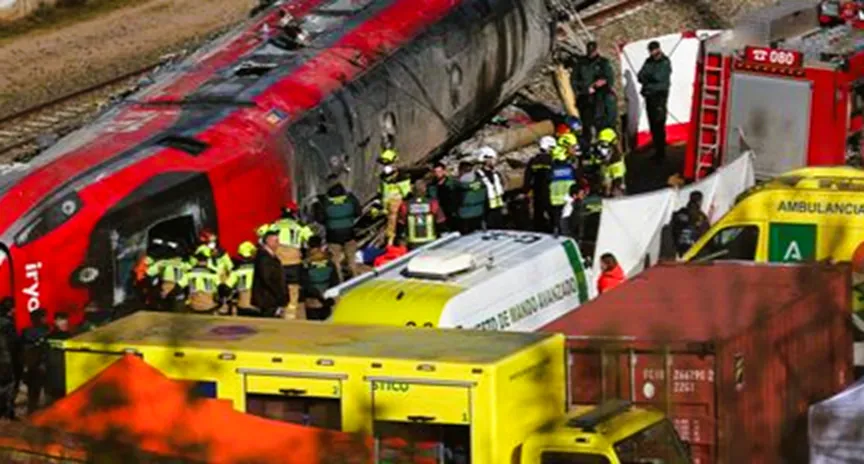
The Adamuz train derailment has plunged Spain into shock after two passenger trains derailed in southern Spain, resulting in one of the deadliest rail disasters the country has witnessed in years. Disturbing images and videos from the crash site show mangled carriages, debris scattered across the tracks, and emergency crews battling difficult terrain to reach survivors.
The accident occurred near the town of Adamuz, located in Córdoba province, an area not typically associated with major rail incidents. As authorities continue rescue, recovery, and investigation efforts, questions are mounting about how such a tragedy could occur on Spain’s modern rail network.
What Happened in the Adamuz Train Derailment
According to Spain’s state broadcaster RTVE, the Adamuz train derailment involved two passenger trains operating on the same corridor. Initial reports indicate that one high-speed service derailed and crossed onto an adjacent track, where it collided with another train traveling in the opposite direction.
The force of the impact caused several carriages to overturn and slide down an embankment, significantly complicating rescue operations. Emergency responders described scenes of chaos, with twisted metal, damaged rail infrastructure, and passengers trapped inside wrecked coaches.
Rescue Operations and Emergency Response
Following the Adamuz train derailment, Spanish authorities launched a massive emergency response, sending firefighters, medical teams, civil protection units, and law enforcement to the crash site within minutes of the first alerts.
The area’s rugged terrain and limited access roads slowed rescue efforts. Emergency crews airlifted some injured passengers to hospitals in Córdoba and nearby cities, while medical teams treated others at temporary stations near the tracks.
Officials confirmed that hospitals across the region activated mass-casualty protocols to handle the influx of injured survivors. Psychological support teams were also dispatched to assist victims and families affected by the Adamuz train derailment.
Investigation Into the Cause
Investigators continue to examine the cause of the Adamuz train derailment. Spanish transport authorities say it is too early to draw conclusions, but investigators are reviewing multiple possibilities.
Investigators are focusing on:
- Track conditions and recent maintenance work
- Signaling and communication systems
- Possible mechanical failures
- Data from onboard recorders
Authorities have emphasized that there is currently no official confirmation of human error or excessive speed. The section of track involved was reportedly considered safe, making the incident particularly troubling for rail safety experts.
National Impact and Public Reaction
The Adamuz train derailment has triggered nationwide mourning and renewed debate about rail safety in Spain. Political leaders expressed condolences to the families of victims, while calls have grown louder for a transparent and thorough investigation.
Spain has long promoted its high-speed rail system as one of the safest and most advanced in Europe. This tragedy has shaken public confidence and raised concerns about infrastructure oversight, especially as rail traffic continues to increase.
Several rail services in southern Spain were temporarily suspended following the accident, causing widespread travel disruption and leaving thousands of passengers stranded.
Why the Adamuz Train Derailment Matters
Beyond the immediate loss of life, the Adamuz train derailment represents a critical moment for Spain’s transportation system. Rail experts warn that even rare incidents can expose systemic vulnerabilities, particularly when high-speed trains are involved.
The disaster has reignited discussions about:
- Infrastructure investment
- Independent safety audits
- Emergency preparedness in remote areas
- Transparency in accident reporting
As Spain awaits the final investigation report, the Adamuz train derailment is likely to influence rail policy and safety standards for years to come.
FAQ
About the Author: GRV is a digital media writer who created Dumbfeed, a platform that simplifies complex global and political news into clear, engaging, and family-friendly formats. He delivers accurate, easy-to-understand explanations that help readers stay informed without the noise. When he’s not writing, GRV produces video content and short-form news updates for social media.