History rarely repeats itself in perfect cycles. Yet sometimes it produces patterns that are difficult to ignore. One of the more intriguing examples currently circulating among historians and geopolitical observers is the 1914 and 2026 calendar coincidence — a reminder that timelines in history can sometimes echo across generations.
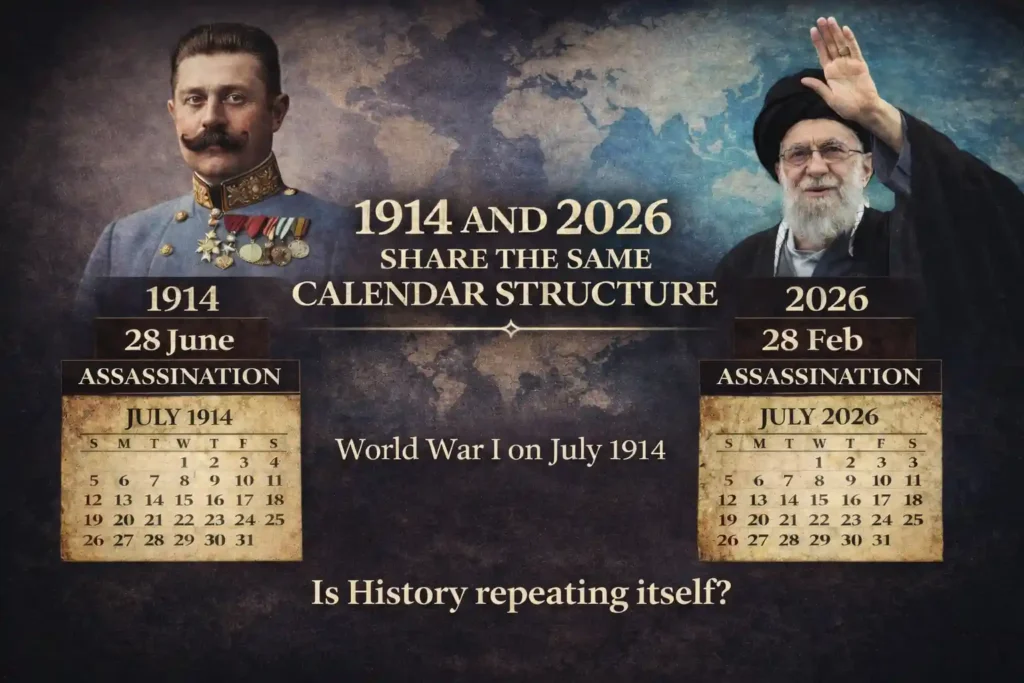
In simple terms, the structure of the calendar year for 2026 aligns almost perfectly with that of 1914. The same dates fall on the same days of the week throughout the year. On its own, this might appear to be nothing more than an interesting mathematical quirk of the Gregorian calendar. But when placed alongside what happened in 1914 — the year the world plunged into the First World War — the coincidence has sparked renewed curiosity about how historical timelines unfold.
On June 28, 1914, the assassination of Archduke Franz Ferdinand in Sarajevo triggered a chain of diplomatic crises that eventually led to the outbreak of World War I. Historical records from the National WWI Museum and Memorial describe how the event became the catalyst for the wider conflict across Europe.
Today, the alignment of the 1914 and 2026 calendar structure has prompted analysts to revisit the historical timeline — not to suggest a repeat of events, but to examine how geopolitical tensions can escalate when global systems become fragile.
The Historical Background: A Timeline That Changed the World
In early 1914, Europe was already a continent under pressure. Rival empires competed for influence, military alliances were tightly bound, and nationalist movements were reshaping political identities across the continent.
The assassination of Archduke Franz Ferdinand in Sarajevo by a nationalist extremist set off a cascade of diplomatic confrontations. Within weeks, alliance obligations forced several major powers into confrontation.
The timeline moved quickly. Austria-Hungary declared war on Serbia. Russia mobilized to support Serbia. Germany declared war on Russia and France. Britain entered the conflict soon afterward. By August 1914, what began as a regional crisis had expanded into a global war.
Looking back, historians often note how rapidly the diplomatic situation deteriorated. The early months of 1914 contained warning signs — tensions that many policymakers underestimated until it was too late.
The Calendar Alignment: Why 1914 and 2026 Match
The Gregorian calendar repeats in cycles due to leap-year rules and the mathematical structure of weeks. In certain years, the entire calendar pattern — including how dates align with weekdays — repeats.
The 1914 and 2026 calendar alignment is one of those cycles. This means that if June 1 fell on a Monday in 1914, it falls on a Monday in 2026 as well. The same pattern continues throughout the year.
Such repetitions occur periodically throughout history, though they often pass unnoticed. What makes this particular coincidence noteworthy is the historical weight attached to 1914. For historians, the comparison offers a symbolic reminder of how seemingly ordinary timelines can contain extraordinary turning points.
Current Global Developments
Unlike the rigid alliance systems of early twentieth-century Europe, today’s geopolitical landscape is more complex. Power is distributed across several major states rather than concentrated within a few imperial blocs.
However, tensions remain visible in several regions. Meanwhile, strategic competition between major powers continues to intensify. In addition, disputes over trade routes and critical resources have further complicated the geopolitical landscape. Moreover, ongoing regional conflicts and the rise of nationalist politics are contributing to an increasingly unpredictable international environment.
While modern institutions such as the United Nations and global economic networks help stabilize the system, geopolitical rivalry has hardly disappeared.
In this context, discussions about the 1914 and 2026 calendar coincidence have taken on a symbolic tone in geopolitical commentary. Analysts sometimes use it as a historical lens through which to reconsider how quickly crises can escalate when political tensions are left unresolved.
Lessons From the Pre-War Timeline
The most important lesson from 1914 is not the calendar itself, but the speed at which diplomatic failures can cascade into larger conflicts. Several factors contributed to the outbreak of war in 1914:
- Rigid alliance structures
- Military mobilization plans that left little room for diplomacy
- Nationalist movements inflaming public opinion
- Miscalculations by political leaders
Modern geopolitics operates under very different conditions, but some parallels remain. Strategic rivalries, military buildups, and competing security guarantees can still create volatile situations.
For historians and analysts, revisiting the 1914 timeline serves as a reminder that geopolitical crises rarely emerge suddenly. Instead, they build gradually through unresolved tensions.
Possible Global Consequences
It would be misleading to interpret the 1914 and 2026 calendar coincidence as a prediction of future conflict. History does not operate according to repeating schedules. However, the comparison highlights an important analytical point: moments that appear stable can sometimes conceal deeper geopolitical instability.
If major international crises were to emerge in the coming years, historians might again examine the broader structural conditions that made them possible. The real significance of the calendar coincidence lies not in forecasting events but in encouraging deeper reflection on how global tensions evolve. History may not repeat itself — but it often rhymes.
Conclusion
The alignment between the 1914 and 2026 calendar is ultimately a mathematical curiosity. Yet it has captured attention because of the historical weight carried by 1914 — a year that reshaped the global order.
Looking back at the months preceding the First World War reminds us that global conflicts rarely begin with a single event alone. They grow out of accumulated tensions, strategic rivalries, and political miscalculations. The calendar may repeat. History rarely does. But the lessons of the past remain as relevant as ever.