At the dawn of the 20th century, Europe’s most powerful leaders weren’t just political rivals—they were family. Bound by blood and royal lineage, they shared history, culture, and even personal relationships. Yet, when World War I erupted in 1914, those same ties collapsed under the weight of ambition, alliances, and mistrust.
This is the story of how a closely connected royal network failed to prevent one of the deadliest conflicts in human history—and what it reveals about the limits of personal diplomacy.
Background: A Royal Web Across Europe
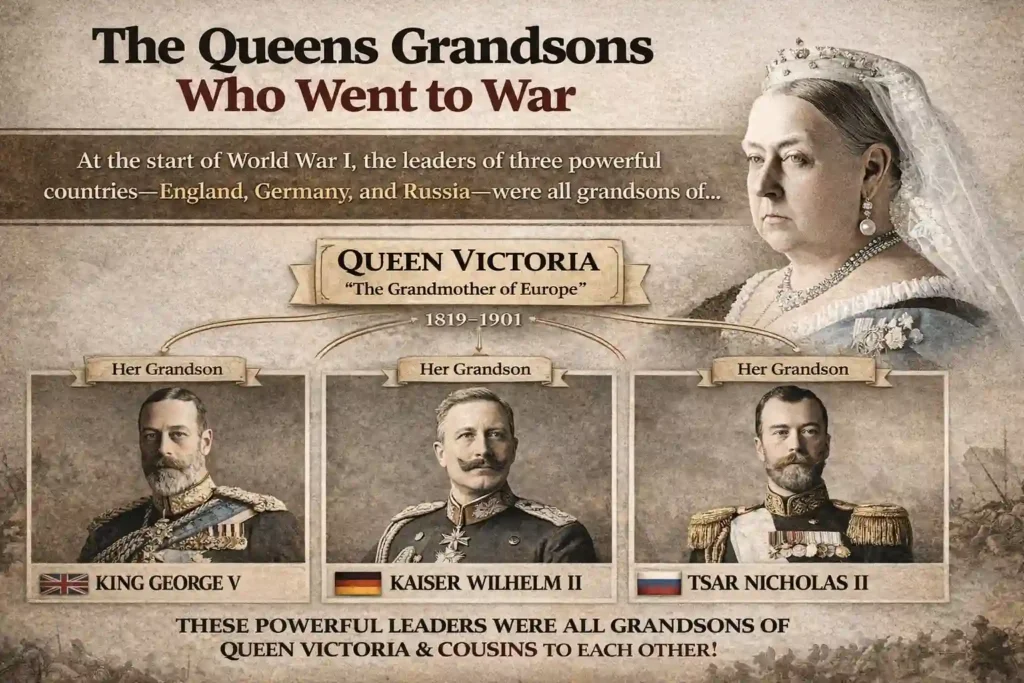
In the late 19th century, Queen Victoria earned the title “the grandmother of Europe” for a reason. Through strategic marriages, her descendants occupied thrones across the continent, forming a vast dynastic network that many believed would ensure peace. By 1914, three of Europe’s most powerful rulers—Britain’s King George V, Germany’s Kaiser Wilhelm II, and Russia’s Tsar Nicholas II—were all her grandsons. They were not distant relatives; they were first cousins who had grown up attending family gatherings and royal ceremonies together.
Yet beneath this appearance of unity, Europe was becoming increasingly unstable. Nationalism was rising. Military competition was intensifying. Alliances were forming along rigid lines. For a broader historical overview of the causes and escalation of World War I, refer to this detailed analysis by Encyclopaedia Britannica.
The Breaking Point: Alliances Over Blood
The assassination of Archduke Franz Ferdinand in June 1914 triggered a chain reaction. But the deeper causes of World War I had been building for years. Despite their personal relationships, the three monarchs found themselves trapped in a web of alliances:
- Britain aligned with France and Russia
- Germany backed Austria-Hungary
- Russia positioned itself as a protector of Slavic nations
These alliances were not flexible. They were strategic commitments backed by military plans that demanded rapid mobilization. Even as the monarchs exchanged personal telegrams—famously known as the “Willy-Nicky correspondence”—their governments moved toward war. Emotional appeals and family bonds proved powerless against geopolitical realities.
The Illusion of Personal Diplomacy
One of the most striking aspects of World War I is how quickly personal diplomacy failed. Kaiser Wilhelm II believed his relationship with Tsar Nicholas II could prevent escalation. King George V hoped that shared heritage might de-escalate tensions. But these assumptions underestimated the structural forces at play.
By 1914, Europe was no longer governed by personal rule alone. Bureaucracies, military leadership, and nationalist public opinion had grown powerful enough to override individual decisions. In essence, the monarchs were no longer fully in control of their own nations.
Geopolitical Analysis: Why Family Didn’t Matter
The failure of royal family ties to prevent World War I highlights a critical geopolitical lesson: shared identity does not override strategic interests. Several factors explain why:
1. Rise of Nationalism
Citizens increasingly identified with their nation, not with royal families. Public pressure pushed leaders toward aggressive postures.
2. Militarization and War Planning
Countries had detailed war plans (like Germany’s Schlieffen Plan) that required quick execution. Once set in motion, they were difficult to stop.
3. Alliance Rigidity
The alliance system created a domino effect. A regional conflict quickly escalated into a global war.
4. Decline of Monarchial Authority
Although monarchs still held power, decision-making was increasingly shared with political and military institutions.
Global Consequences: A War That Changed Everything
The collapse of this “family network” had profound consequences that reshaped the world:
- The fall of major empires: German, Russian, Austro-Hungarian, and Ottoman
- The rise of new nation-states in Europe and the Middle East
- Economic devastation and political instability
- The eventual conditions that led to World War II
Perhaps most importantly, World War I marked the end of an era where personal relationships between rulers could influence global stability.
A Modern Parallel: Lessons for Today’s Geopolitics
While today’s leaders are not bound by royal bloodlines, the core lesson remains relevant: personal relationships between leaders cannot override structural geopolitical tensions. We see echoes of this in modern conflicts, where economic ties, diplomatic meetings, and personal rapport often fail to prevent escalation when national interests clash. The story of World War I serves as a reminder that peace requires more than relationships—it requires aligned interests, stable institutions, and flexible diplomacy.
Conclusion: When History Chose Power Over Blood
The outbreak of World War I was not simply a failure of diplomacy—it was a failure of assumptions. European leaders believed that shared heritage and personal connections would act as a safeguard against war. They were wrong. In the end, alliances, ambitions, and fears proved stronger than family. The result was a conflict that reshaped the global order and demonstrated a timeless truth: in geopolitics, power often outweighs personal bonds.