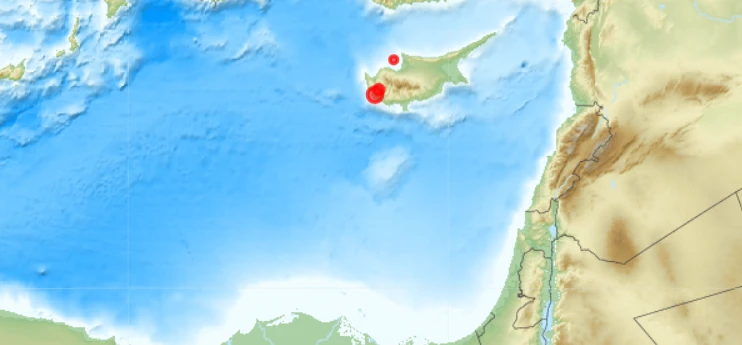
A strong Cyprus earthquake shook the eastern Mediterranean on Wednesday. It struck near Paphos, sending tremors through Cyprus, Israel, and Lebanon. The quake measured 5.4 magnitude, followed by a stronger 5.9 aftershock later in the day. Seismic experts say it was one of the most significant regional events this year.
A Day of Shaking in Cyprus earthquake
People in Paphos, Nicosia, and Limassol felt the ground move for several seconds. Offices and schools briefly evacuated as a safety measure. Many residents described it as “a rolling wave,” while others heard furniture and glass rattling.
Officials confirmed there was no serious damage. However, the Civil Defence Department urged citizens to stay alert for aftershocks.
The Cyprus Geological Survey located the epicenter about 20 kilometers northwest of Paphos, at a shallow depth of 15 kilometers. Because the quake occurred close to the surface, its vibrations traveled far across the Mediterranean.
Tremors Felt Across Israel and the Region
The Cyprus earthquake reached Israel, shaking homes in Haifa, Nazareth, and Tiberias. The Israel Geological Survey confirmed the tremors came from Cyprus, not from a local fault.
Residents said their windows and ceiling lights swayed. Some called emergency lines to report the shaking, though no injuries or damage occurred.
People in southern Turkey, Lebanon, and northern Egypt also felt mild tremors. The quake was among the most widely sensed events in the eastern Mediterranean this year.
Why Cyprus Is Prone to Earthquakes
Cyprus lies between the African and Eurasian tectonic plates. Their slow but constant movement makes the island seismically active.
Seismologists note that this Cyprus earthquake fits a long pattern of stress buildup in the region. The same geological forces also affect Turkey, Greece, and Israel.
The Cyprus Arc, a fault zone south of the island, has produced many strong quakes through history. Thanks to improved infrastructure and awareness, modern Cyprus faces less danger from moderate quakes than in the past.
Aftershocks and Ongoing Monitoring of the Cyprus Earthquake
After the main shock, smaller aftershocks followed near Paphos. They ranged between 3.2 and 4.7 in magnitude. Scientists warned that more minor tremors could occur in the next few days as the crust settles.
The Cyprus Seismological Center placed sensors around the area for closer observation. Local teams remain ready to respond to any emergency.
In Israel, researchers are studying whether the seismic waves affected the Dead Sea fault system, one of the region’s most active fault lines.
No Tsunami Threat Issued
Despite the strength of the Cyprus earthquake, officials said there was no tsunami danger. The Mediterranean Tsunami Warning Centre reviewed data and found no vertical seabed movement that could trigger one.
Still, coastal authorities briefly monitored sea levels before confirming normal conditions.
Regional and International Reactions to the Cyprus Earthquake
Officials from Cyprus and Israel praised emergency responders for their quick coordination. Cyprus’s Interior Ministry reminded citizens to keep emergency kits ready and review safety plans.
The European Union Civil Protection Mechanism also monitored the event and offered help if needed.
Media outlets across the region covered the quake extensively. Many highlighted how seismic waves can travel easily through the Mediterranean basin.
Rising Seismic Activity in the Mediterranean
The eastern Mediterranean has seen a rise in moderate quakes this year. Experts believe it results from the African plate pushing slowly northward.
Most events remain small, but scientists warn that larger quakes are always possible in this region. The Cyprus earthquake shows how even a mid-sized event can shake several countries.
Preparedness and solid infrastructure remain the best defense. Authorities encourage people to stay calm, follow verified updates, and know what to do if another quake occurs.
Conclusion
The Cyprus earthquake near Paphos caused no major damage; however, it clearly reminded the region of its ongoing seismic reality. Moreover, the tremors across Israel and nearby countries demonstrated how deeply interconnected the Mediterranean’s fault systems are, emphasizing the shared geological vulnerability of the entire region.
Experts continue to monitor for aftershocks, and meanwhile, they emphasize the importance of preparedness. Ultimately, in a region defined by shifting plates, staying alert and ready remains the strongest safety measure.
Source: CSEM EMSC
For more on current events, check out our full coverage of the RBI Introduced the Indian Banks New Domain and stay updated on the latest developments.