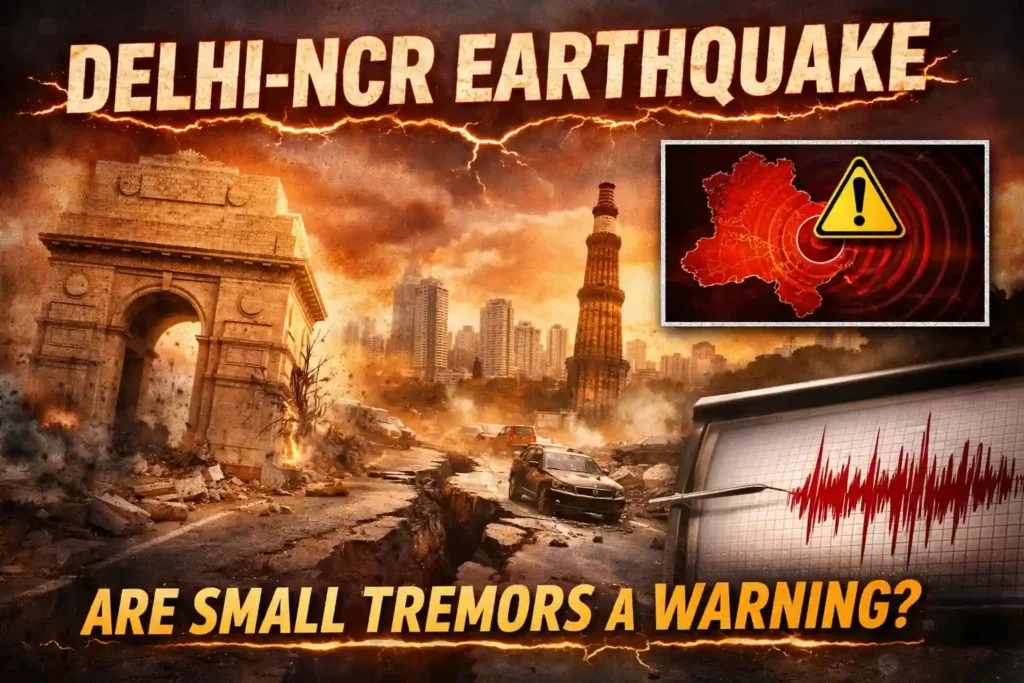
The Delhi-NCR earthquake today, though mild in magnitude, has once again brought seismic safety into sharp public focus. Early morning tremors were felt across Delhi and parts of the National Capital Region, briefly unsettling residents and triggering widespread discussion on social media. While no damage or injuries were reported, the event has revived an important question: are these small earthquakes early warning signs of a larger seismic threat?
According to the National Centre for Seismology, the earthquake measured 2.8 on the Richter scale, with its epicentre located in North Delhi at a shallow depth. Experts confirm that shallow earthquakes, even when low in magnitude, are often felt more strongly at the surface—especially in densely populated urban areas like Delhi.
For official seismic updates and real-time data, readers can refer to the National Centre for Seismology’s website.
Delhi-NCR Earthquake Today: What Exactly Happened?
The Delhi-NCR earthquake today occurred at a depth of roughly 5 kilometres, making the tremors more noticeable than deeper quakes of similar magnitude. Residents across North, Central, and parts of West Delhi reported mild shaking, rattling windows, and momentary swaying of ceiling fans.
Such tremors are not uncommon in the region. Delhi lies close to several active fault lines, including the Delhi-Haridwar Ridge and the Mahendragarh–Dehradun Fault, which periodically release built-up tectonic stress in the form of small earthquakes.
While today’s quake caused no harm, its shallow nature explains why it was widely felt despite being classified as “minor” on seismic scales.
Why Does Delhi Experience Frequent Earthquakes?
Delhi and the NCR fall under Seismic Zone IV, one of the highest risk categories in India. This classification indicates a high probability of moderate to strong earthquakes in the future.
The Indian subcontinent sits on the Indian tectonic plate, which continues to collide with the Eurasian plate. This ongoing movement created the Himalayas and still generates stress across northern India. Delhi, though far from the Himalayan epicentre zones, remains affected due to interconnected fault systems beneath the region.
In simple terms, small earthquakes are the Earth’s way of releasing accumulated stress. However, scientists caution that frequent low-magnitude tremors do not necessarily prevent a larger earthquake from occurring.
Are Small Earthquakes a Warning Sign?
This is the question many residents ask after every Delhi-NCR earthquake today alert.
Seismologists agree on one point: small earthquakes are not reliable predictors of larger ones. While clusters of tremors may indicate active fault movement, there is currently no scientific method to predict when or where a major earthquake will strike.
That said, repeated tremors serve as important reminders:
- Delhi is seismically active
- Infrastructure readiness matters
- Public awareness can save lives
Rather than viewing small earthquakes as panic signals, experts recommend treating them as wake-up calls for preparedness.
Urban Risk: Why Delhi Is Particularly Vulnerable
Delhi’s risk is not just geological—it is also structural.
Many buildings in the city, especially older constructions and unauthorized structures, do not fully comply with earthquake-resistant building codes. High population density, congested neighborhoods, and aging infrastructure significantly increase potential damage during a stronger quake.
Rapid urbanization in NCR cities like Gurugram, Noida, and Ghaziabad has further intensified the risk, making earthquake preparedness a critical urban planning issue rather than just a geological concern.
What Should Residents Do After the Delhi-NCR Earthquake Today?
Even after a mild tremor, authorities advise residents to remain cautious:
- Check buildings for visible cracks
- Secure heavy furniture and appliances
- Keep emergency kits ready
- Identify safe spots like sturdy tables or door frames
- Stay informed through official government updates
Preparedness does not mean fear—it means readiness.
The Bigger Picture: Learning From Today’s Tremors
The Delhi-NCR earthquake today caused no harm, but it highlighted an uncomfortable truth: Delhi is not earthquake-proof.
While small tremors may feel routine, complacency can be dangerous. Cities like Tokyo and San Francisco demonstrate that earthquake resilience comes from strict building standards, public drills, and continuous awareness—not from ignoring warning signs.
FAQ
About the Author: GRV is a digital media writer who created Dumbfeed, a platform that simplifies complex global and political news into clear, engaging, and family-friendly formats. He delivers accurate, easy-to-understand explanations that help readers stay informed without the noise. When he’s not writing, GRV produces video content and short-form news updates for social media.