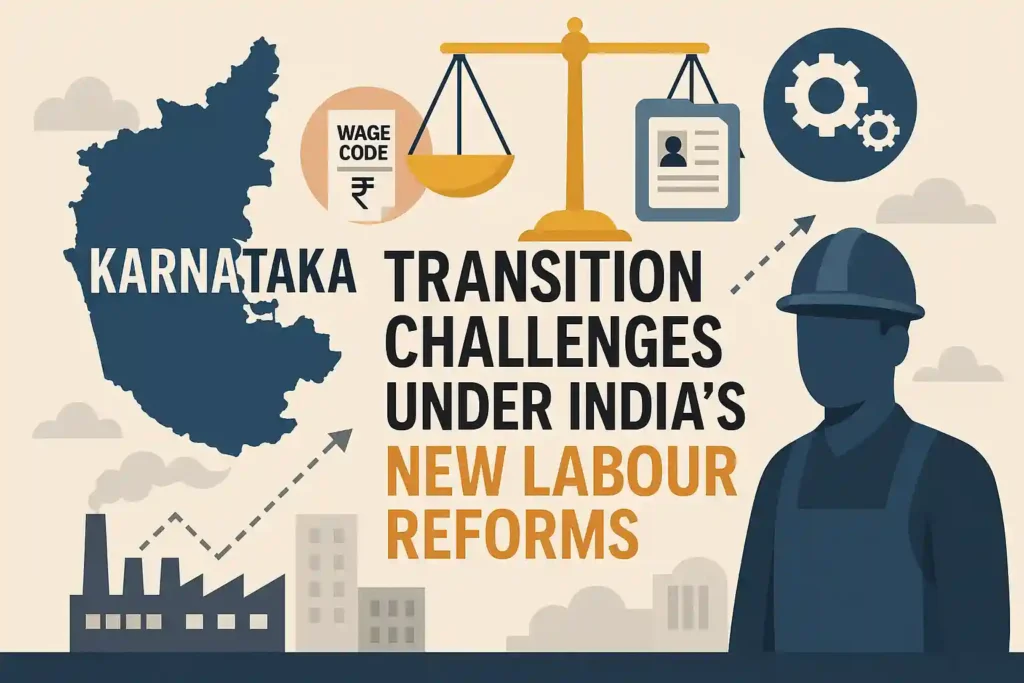
Karnataka is entering a crucial transition period as India’s new labour reforms come into force. Moreover, these changes—spread across wages, social security, industrial relations, and workplace safety—are reshaping how employers, workers, and gig platforms operate. Consequently, with Karnataka labour law adapting to new national standards, industries across the state are preparing for an extensive compliance shift.
How Karnataka Labour Law Is Changing Under the New Reforms
The reforms mandate written appointment letters for nearly all categories of workers, including contract, fixed-term, and gig workers. For Karnataka employers, this brings a more formalised structure to job roles, work conditions, payment cycles, and leave rules. It also aims to reduce disputes by clearly defining employment terms from the start.

Gratuity and Social Security Reforms
One of the most significant updates is the introduction of gratuity eligibility after just one year of continuous service for fixed-term employees. This brings parity between permanent and fixed-term workers.
Additionally, the social security framework now extends to gig and platform workers, a major development for Karnataka’s thriving digital and delivery economy. Aggregators in the state will need to contribute to social security funds to support these workers.
Wage Standardisation and Equality
The reforms introduce a national floor wage, and Karnataka labour law will need to align its wage calculations accordingly. This aims to minimise wage disparities across industries and ensure fair compensation.
Equal wages for men and women and greater flexibility for women to work in various job categories, including night shifts, are also part of the new structure.
Compliance Challenges for Businesses Under Karnataka Labour Law
While the reforms promise simplification in the long run, the transitional phase is challenging for small and medium enterprises. Karnataka businesses must adjust to new norms such as single registration, single return filing, and digital record maintenance.
The new industrial relations rules—particularly the threshold for approvals related to layoffs and closures—influence how larger establishments plan workforce changes.
Impact on Gig and Platform Work
Karnataka is one of the states that has taken additional steps to protect gig workers through its own policies. Under the new reforms, the state’s gig economy—ranging from delivery partners to app-based service providers—now falls under clearer legal protection. This is expected to improve worker welfare while increasing responsibility on platform companies.
The Road Ahead for Karnataka
The success of these changes depends heavily on how fast Karnataka labour law aligns its rules with the national codes. Businesses are awaiting further state-level notifications to understand the detailed compliance steps.
For now, the focus remains on adjusting internal systems, updating employment contracts, training HR teams, and preparing for new inspection and governance models.
The coming months will test the readiness of industries, but the reforms promise a more modern and transparent labour landscape for Karnataka.
Source: Official Website of Government of Karnataka
For more on current events, check out our full coverage on The recent Tejas incident has sparked a wave of questions about safety, performance, and reliability and stay updated on the latest developments.