
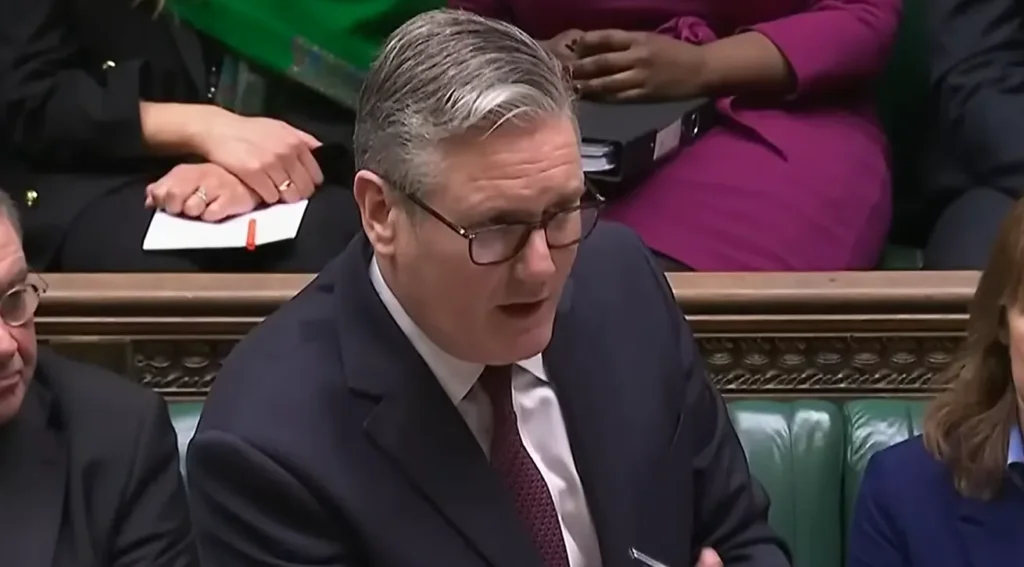
The Keir Starmer Epstein speech delivered in Parliament has ignited a political storm across the United Kingdom, triggering fierce opposition criticism, internal Labour unease, and a growing public debate over accountability at the highest levels of government.
In a rare admission from a sitting prime minister, Keir Starmer told Parliament that he regretted appointing a senior figure who later misled the government about links to Jeffrey Epstein. He said the individual repeatedly lied to him and made clear that, had he known the truth earlier, he would never have approved the appointment. Instead of closing the issue, the speech has deepened political divisions. It has raised fresh questions about judgment, vetting processes, and whether an apology alone can rebuild public trust.
The Prime Minister spoke directly from the House of Commons, acknowledging that he had been misled and expressing regret over the appointment. The full statement is recorded in the official UK Parliament proceedings, where Starmer told MPs that had he known then what he knows now, the individual would never have been appointed. The complete speech is available through the UK Parliament’s Hansard record, which documents all parliamentary debates and statements
What Starmer Said in Parliament
The Keir Starmer Epstein speech stood out for its blunt tone, not defensive rhetoric. Starmer accepted responsibility for the appointment and admitted he had relied on false assurances. He said the situation betrayed the country, Parliament, and his own party.
Political observers note that modern British leaders rarely use such direct language. They often shift blame to advisers or inherited systems instead. Starmer chose to take responsibility as a form of damage control. That choice also drew sharper scrutiny.
Starmer did not deny that warning signs existed before the appointment. He admitted the system failed to catch them in time. This admission has now become a key focus of opposition attacks.
Opposition Reaction: “Too Little, Too Late”
Opposition parties moved quickly to capitalise on the fallout from the Keir Starmer Epstein speech. Conservative MPs accused the Prime Minister of poor judgment. They argued the controversy shows a deeper failure of leadership, not just a single mistake. Several senior figures questioned how such assurances were accepted, especially given Epstein’s widely known history.
Liberal Democrat leaders raised similar concerns. They called for greater transparency in the appointment process and urged the release of all relevant documents. Meanwhile, Reform UK described the issue as evidence of entrenched establishment culture. The party argued that accountability often comes only after public exposure.
Across the opposition benches, the message was clear. Starmer’s apology may have been necessary, but it does not close the matter.
Reaction Within Labour Ranks
The impact of the Keir Starmer Epstein speech has not been limited to opposition parties. Within Labour, the response has been more cautious — but far from unified.
Some Labour MPs privately welcomed the Prime Minister’s candour, arguing that admitting mistakes is preferable to denial. Others, however, expressed concern that the admission has weakened the government at a time when political stability is already under pressure.
There have been quiet calls for reforms to appointment and vetting procedures, with some MPs warning that public trust in Labour’s promise of “clean government” is at risk if systemic changes do not follow.
Public Reaction and Online Debate
Among UK citizens, reaction to the Keir Starmer Epstein speech has been deeply divided.
On social media, many users praised Starmer for taking responsibility and contrasted his approach with past leaders who avoided accountability. Others reacted more critically, saying the admission raises deeper questions — especially about why officials accepted those assurances in the first place.
Public commentators have pointed out that Epstein-related controversies carry unique emotional and moral weight, making any perceived lapse in judgment especially damaging. For many voters, the issue is not just political competence, but moral credibility.
Why This Moment Matters Politically
The long-term consequences of the Keir Starmer Epstein speech may extend beyond the immediate controversy.
First, it has reopened debate about transparency in government appointments. Second, it has given opposition parties a narrative that challenges Labour’s claim to ethical renewal. Third, it tests whether voters reward honesty — or punish failure — when leaders admit mistakes.
Political analysts suggest that Starmer’s leadership will now be judged less by the speech itself and more by what follows: policy changes, procedural reforms, and a clear demonstration that lessons have been learned.
What Happens Next?
In the days ahead, MPs are likely to renew calls for document disclosures and committee scrutiny. The government has said it will cooperate with ongoing inquiries, but political pressure shows no sign of easing.
For now, the Keir Starmer Epstein speech stands as one of the most defining moments of his premiership — a moment that may ultimately shape public perceptions of accountability, trust, and leadership in modern British politics.
FAQ
About the Author: GRV is a digital media writer who created Dumbfeed, a platform that simplifies complex global and political news into clear, engaging, and family-friendly formats. He delivers accurate, easy-to-understand explanations that help readers stay informed without the noise. When he’s not writing, GRV produces video content and short-form news updates for social media.