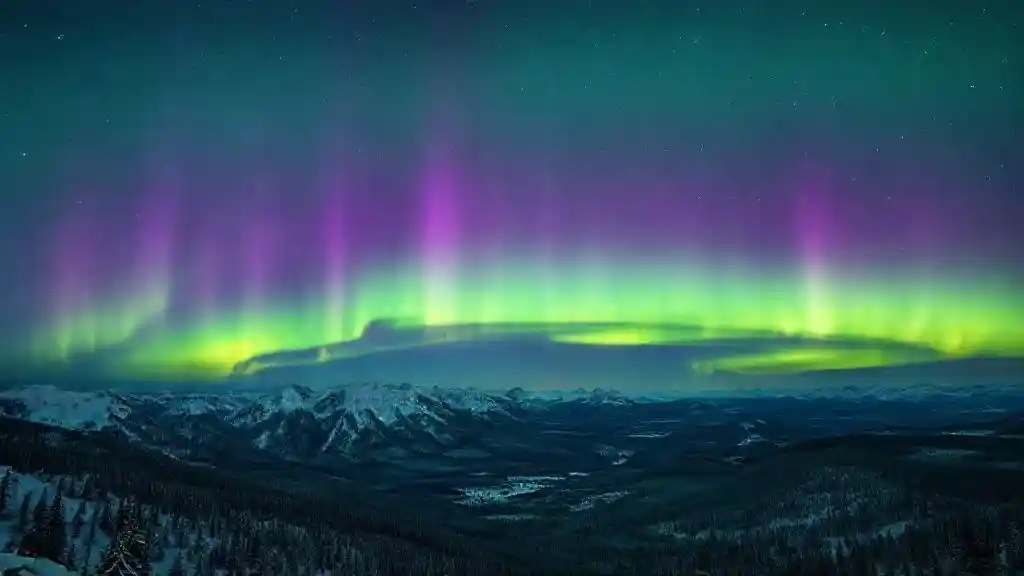
A rare celestial display is unfolding across the United States. Meanwhile, the Aurora Borealis — more popularly known as the northern lights USA — is now visible far beyond its usual northern range. As a result, many regions that rarely witness this phenomenon are experiencing vibrant skies. Thanks to a powerful solar eruption and a strong geomagnetic storm, skies from the northern tier to the mid-latitudes now glow with shimmering curtains of light. In addition, experts believe the event marks one of the most widespread auroral displays in recent years.
What’s happening?
The NOAA’s Space Weather Prediction Center (SWPC) issued an alert after a strong solar flare and coronal mass ejection (CME) struck Earth’s magnetic field. This disturbance increased geomagnetic storm levels and expanded the auroral oval southward. As a result, the northern lights USA may now appear in places where they are rarely seen.
For the period covering 10–12 November 2025, K-index and geomagnetic conditions suggest high probabilities of aurora visibility across much broader swathes of the U.S. than normal.
Where in the U.S. to see it
Because the auroral oval has grown, the northern lights USA could be visible in 15–25 states. Reports also suggest that up to 21 U.S. states might witness this extraordinary sight.
Best chances are in northern states such as Alaska, Washington, Montana, Minnesota, and Michigan. However, this storm has boosted the odds farther south — even into parts of Northern California, Iowa, Pennsylvania, and beyond.
When and how to view
- Timing: Late evening through early morning (roughly 8 p.m.–2 a.m. local time) is prime. Clear, dark skies are key.
- Direction: Look toward the northern horizon; the aurora may appear as a greenish or reddish glow, dancing curtains, or rays.
- Conditions: The clearer and darker your surroundings (away from city lights) the better your chance of seeing the northern lights USA in all their glory. A camera in night mode or with long exposure may capture details that your eyes might miss.
Why now?
The sun is currently in a very active phase of its 11-year solar cycle. Recent X-class flares and CMEs have sent charged particles hurtling toward Earth. When these particles collide with Earth’s magnetosphere, they excite atmospheric gases, which then release light — giving us the aurora.
In short: the conditions are unusually favourable for a spectacular show of northern lights USA.
What to do (and not do)
- Do: Check real-time aurora maps and space weather alerts for the latest indicators.
- Do: Travel to a dark spot with an open northern view, set up a camera on long exposure, and enjoy the show.
- Don’t: Expect perfection everywhere. Even with favourable conditions, clouds, light pollution, or horizon obstruction can limit visibility.
- Don’t: Plan solely around this event unless you’re flexible — the aurora is beautiful but unpredictable.
Why this matters
Beyond the spectacular visuals, strong geomagnetic storms that bring the northern lights USA also carry potential side effects: disruption to radio communications, GPS signals, satellite operations, and even power grids. It’s a reminder of how intimately connected we are to space weather and the dynamics of our star, the Sun.
Final thought
Whether you’re an avid sky-watcher or simply happen to glance at the northern horizon tonight, if clear skies and a favourable forecast align, you may witness one of nature’s most vibrant light shows right here in the U.S. Don’t miss your chance to see the northern lights USA — it may not happen again quite like this for some time.
Source: National Oceanic and Atmospheric Administration
For more on current events, check out our full coverage on the issue of the Takaichi sumo tradition and stay updated on the latest developments.