
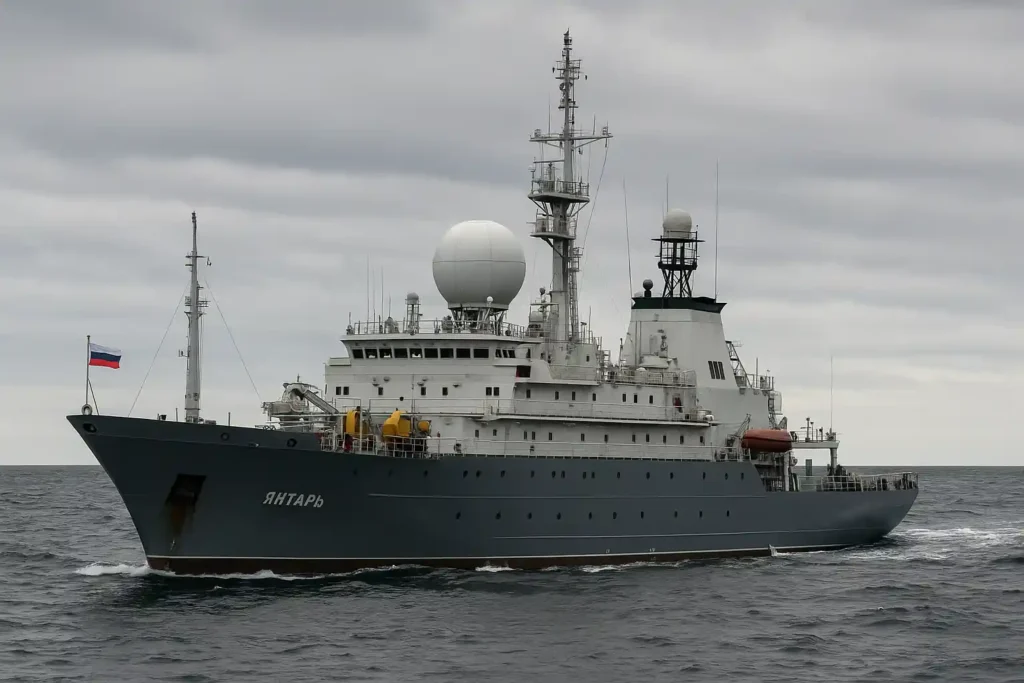
The arrival of a Russian vessel near UK waters has created a new wave of concern for British defence officials. The ship has been active north of Scotland, where it moved through wider maritime zones. Its mission remains unclear, yet its pattern of movement suggests more than routine navigation. UK defence leaders believe the ship operates as an intelligence-gathering platform, which increases the risk to national infrastructure.
Because of this activity, the UK has raised its state of vigilance. The government views the ship’s presence as a sign of growing pressure in the North Atlantic. It also highlights the need for rapid response strategies in the region.
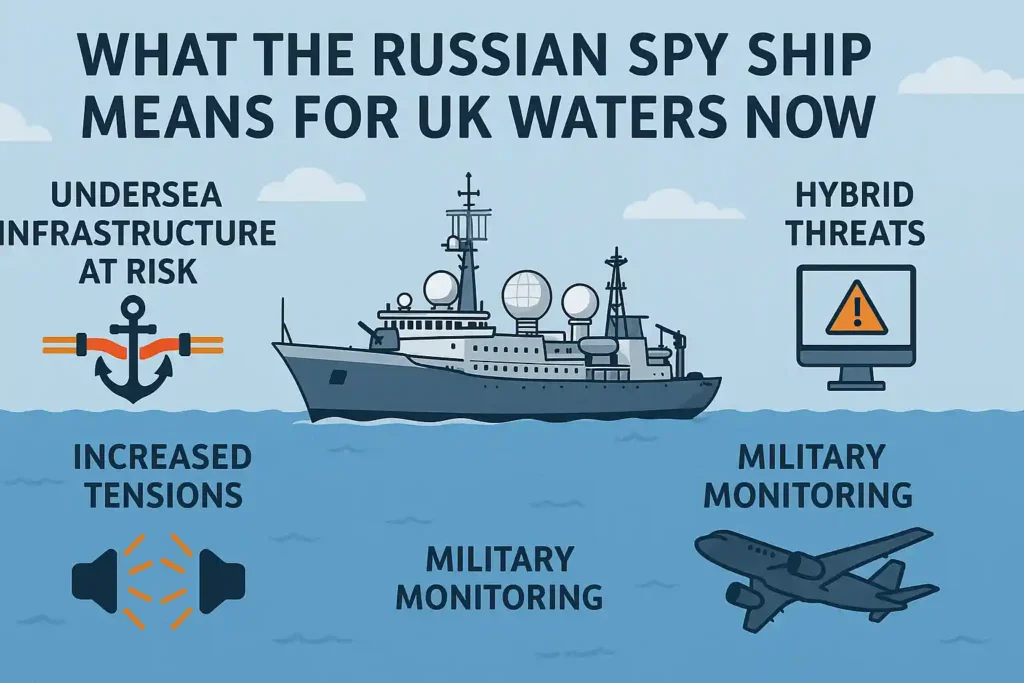
A Rapid UK Military Response
The UK reacted quickly after spotting the Russian vessel near UK waters. The Royal Navy sent a frigate to shadow the ship. At the same time, the RAF deployed a P-8 maritime patrol aircraft to keep constant watch from above. These steps allow the UK to gather real-time information and respond to any sudden changes.
British military leaders confirm that they remain ready for stronger action. They state that the ship will not be allowed to approach sensitive areas unchecked. This firm stance reflects a new phase in the UK’s approach to maritime threats.
Moreover, the UK armed forces want to show that foreign surveillance attempts will face resistance. This message aims to discourage future probing operations by any hostile state.
Why Undersea Infrastructure Is a Prime Target
Under the water’s surface lies a vast network of fibre-optic cables, energy pipelines, and data systems. These systems keep the UK connected to the world. They support communication, business, banking, and government operations. Because they serve as the backbone of modern life, they also create strategic vulnerabilities.
This is why the presence of a Russian vessel near UK waters matters so much. Analysts say the ship has advanced tools that can inspect, map, or possibly tamper with deep-sea infrastructure. If someone disrupts these cables, the consequences could spread across financial markets, communication networks, and essential services.
Additionally, experts warn that adversaries no longer need to attack directly. They only need to understand how these systems work. Knowledge alone can provide leverage in future conflicts or disputes.
Hybrid Threats Are Now a Major Challenge
In the past, countries mainly worried about ships, jets, and submarines entering their territory. However, modern threats look very different. Countries now face a mix of cyber attacks, covert surveillance, and underwater intelligence missions. These actions rarely appear aggressive on the surface, yet they create serious risks.
The appearance of a Russian vessel near UK waters is a clear example of this shift. Instead of traditional weapons, the tension comes from surveillance technology, mapping devices, and unusual naval behaviour. Because these tools stay hidden from public view, they create uncertainty and fear.
Furthermore, hybrid threats often blur the line between peace and conflict. This makes it harder for governments to respond with fixed rules.
Growing Tension in the North Atlantic
The North Atlantic has become a busy and contested region. Russia, the UK, and NATO members all rely on this strategic zone for trade routes and military operations. Because of this, any unexpected vessel raises concerns.
The Russian vessel near UK waters arrived at a time when Europe is facing rising political and military pressure. This timing increases the sense of urgency. It also pushes the UK to strengthen cooperation with allies, especially those that share the same waters.
Moreover, defence analysts believe that Russia is testing responses. By observing how the UK reacts, they learn valuable information. This pattern of probing activity has repeated itself near Norway, Iceland, and the Baltic Sea.
UK Defence Strategy Moving Forward
The UK plans to boost its naval surveillance capabilities. New patrol ships, underwater drones, and advanced sonar systems will soon join the fleet. These upgrades aim to detect unknown vessels faster and more accurately.
The government also intends to protect undersea cables with stronger monitoring systems. These systems will alert military units if anything makes contact with the cables. Additionally, the UK wants to work more closely with NATO partners. Shared intelligence will help everyone detect suspicious activity earlier.
Because the Russian vessel near UK waters has drawn global attention, the UK hopes to accelerate these plans.
Why This Incident Matters for the Public
Although this incident seems distant from daily life, it affects everyone. Modern societies rely on underwater cables every second. Even small disruptions can slow communication, delay transactions, or weaken security systems. This makes the protection of the sea floor as important as the protection of the land and air.
The incident also shows how quickly global tensions can appear close to home. Foreign vessels near national borders can cause political disputes, economic pressure, and military readiness alerts.
For these reasons, understanding the movement of a Russian vessel near UK waters helps the public see the broader picture. It highlights how interconnected the world has become—and why national security now covers many layers.
Source: Financial Times
For more on current events, check out our full coverage of the PS5 Black Friday Sale: Biggest Price Cuts of 2025 and stay updated on the latest developments.