The Supreme Court Aravalli decision has triggered intense debate among environmentalists, legal experts, and policymakers. By introducing a 100-metre height threshold to define what legally qualifies as the Aravalli hills, the Court aimed to bring clarity to a long-pending dispute. However, critics argue that this clarity may come at a significant environmental cost.
The Aravalli range, one of the world’s oldest mountain systems, plays a crucial role in preventing desertification, regulating climate, and recharging groundwater across large parts of north-western India. The concern now is whether the new definition weakens long-standing protections.
What Did the Supreme Court Decide in the Aravalli Case?
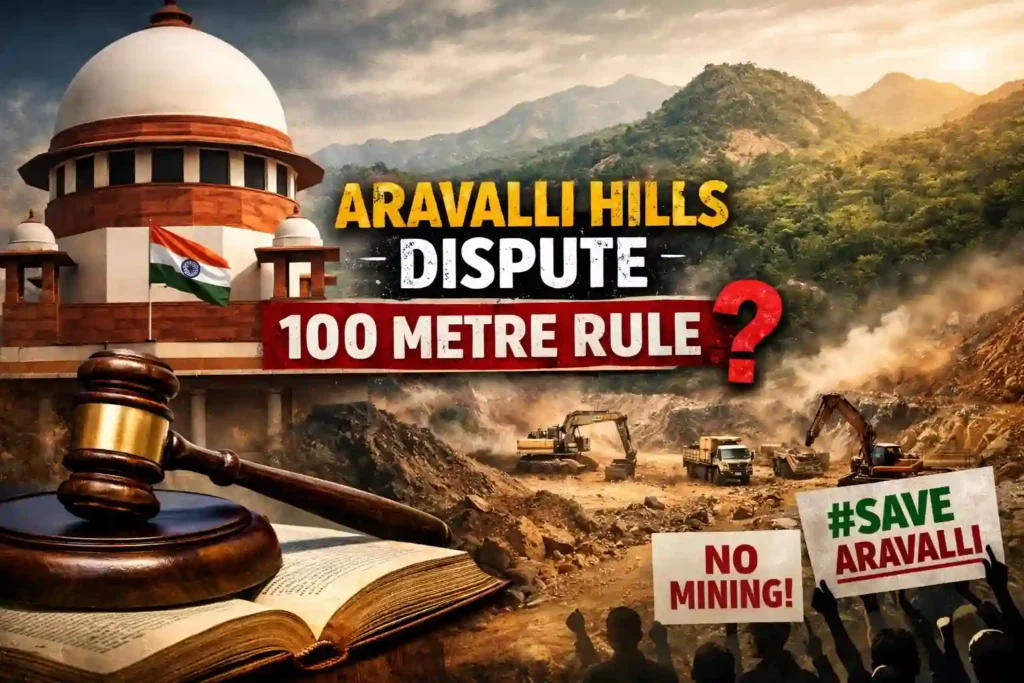
Under the Supreme Court Aravalli decision, only landforms rising 100 metres or more above the surrounding terrain will be officially classified as part of the Aravalli hills.
The Court stated that:
- There was no uniform legal or scientific definition of the Aravallis across states
- Conflicting interpretations had led to administrative confusion and prolonged litigation
- A measurable benchmark was required for consistent enforcement
The ruling applies across states where the Aravallis extend, including Rajasthan, Haryana, Delhi, and Gujarat. The Court also directed authorities to rely on scientific mapping and data rather than ad-hoc classifications.
The Supreme Court’s official judgment on the Supreme Court Aravalli decision can be accessed here: Supreme Court of India – Official Judgment
Why the Supreme Court Aravalli Decision Is Facing Criticism
Environmental experts argue that the Supreme Court Aravalli decision overlooks a key ecological reality:
most of the Aravalli system does not consist of tall hills.
Nearly 90% of the range is made up of low-lying ridges, rocky outcrops, and shallow hill systems, many of which fall below the 100-metre threshold. These formations are essential for:
- Groundwater recharge
- Biodiversity preservation
- Acting as a natural barrier against the expansion of the Thar Desert
- Controlling dust pollution in the NCR region
By excluding these areas from automatic protection, critics fear the ruling may unintentionally expose large tracts of ecologically sensitive land to mining and construction pressures.
Mining Fears and the Risk of Gradual Environmental Damage
A major concern linked to the Supreme Court Aravalli decision is enforcement on the ground.
Historically, illegal mining in the Aravalli belt has often begun on a small scale, exploiting regulatory grey zones before expanding rapidly. Environmentalists warn that once low-height hills lose protected status, monitoring becomes weaker and violations harder to detect.
Damage caused during this early phase is often irreversible, even if restrictions are later reinstated.
What Bhupender Yadav Said About the Aravalli Decision
Union Environment Minister Shri Bhupender Yadav has sought to reassure the public, stating that the Supreme Court Aravalli decision does not automatically permit mining in areas below 100 metres.
According to his public remarks:
- No immediate mining activity will begin
- A committee will be formed to study ecological, groundwater, and biodiversity impacts
- Any future permissions will depend on scientific assessments and sustainability criteria
While procedurally correct, critics argue that committees and reviews often take time, during which enforcement gaps can still be exploited.
Why the Issue Ultimately Comes Down to Implementation
The controversy surrounding the Supreme Court Aravalli decision is not only about definitions, but about governance.
Even a cautious legal framework can fail if:
- Local enforcement remains weak
- Monitoring mechanisms lack transparency
- Environmental violations are addressed only after damage occurs
The Court has effectively shifted responsibility from judicial oversight to executive action, placing the burden on governments to ensure that ecological safeguards are not diluted in practice.