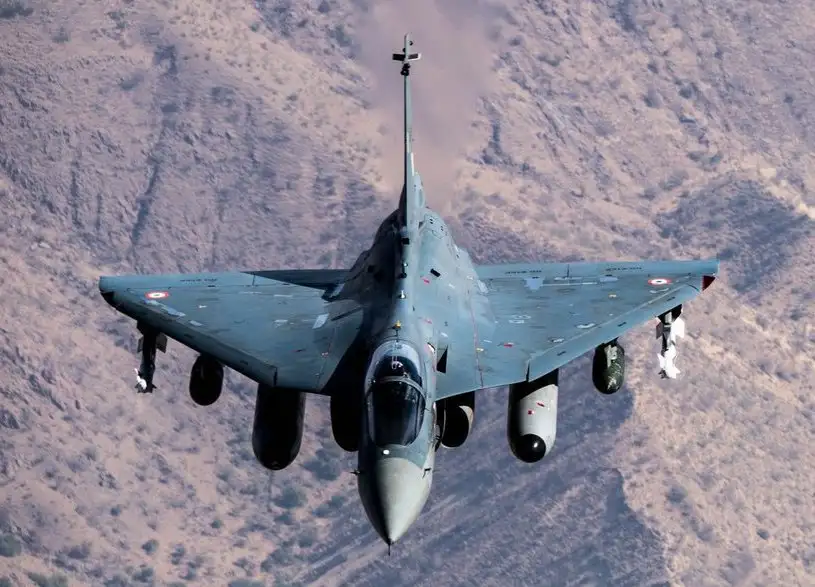
The recent Tejas fighter jet crash in February 2026 has once again brought attention to India’s indigenous fighter aircraft program. While the pilot safely ejected and survived, questions are being asked across defence circles, media, and social platforms: Was this a rare accident, or does it signal deeper problems?
According to a report by The Print, the Tejas fighter jet crash occurred after landing, with preliminary inputs suggesting a suspected brake failure. The Indian Air Force has not issued a detailed public statement so far, and a Court of Inquiry is expected to establish the exact cause.
Let’s understand the full picture behind the Tejas fighter jet crash, without panic or misinformation.
What Happened in the Tejas Fighter Jet Crash?
The incident reportedly took place during a training mission. The aircraft encountered a technical issue during landing or take-off, forcing the pilot to eject. Thankfully, the ejection system worked perfectly, and there were no casualties on the ground.
Initial reports suggest possible causes such as:
- Brake failure after landing
- Runway overrun
- Technical malfunction
However, these are only preliminary observations. Fighter jet crashes are complex events, and final conclusions often take weeks or months. The most important point: the pilot survived, which shows the effectiveness of safety systems built into modern aircraft like Tejas.
Is the Tejas Fighter Jet Safe?
Whenever a Tejas fighter jet crash happens, social media fills with claims that the aircraft is unsafe. But statistics tell a different story. The Tejas Light Combat Aircraft has logged thousands of flight hours over many years. Compared to older aircraft like MiG-21s, its accident rate is relatively low.
In fact:
- Tejas is a modern 4.5-generation fighter
- Built with advanced fly-by-wire controls
- Equipped with modern ejection seats
- Uses upgraded avionics and sensors
Even highly advanced aircraft like the F-16, Rafale, or Su-30MKI have experienced crashes during training sorties. Aviation accidents happen in every country.
So one Tejas fighter jet crash does not automatically mean the aircraft is unsafe.
Why Fighter Jet Crashes Still Happen
Modern fighter jets are extremely complex machines. They operate under intense conditions like high speed, sharp maneuvers, and extreme temperatures.
Common causes of accidents include:
- Mechanical failure
- Human error
- Weather conditions
- Bird strikes
- Maintenance issues
Even with advanced technology, zero-risk aviation does not exist.
This is why every crash leads to a detailed investigation to improve safety procedures.
What Happens After a Tejas Fighter Jet Crash?
The Indian Air Force follows strict steps after any aircraft accident:
- Court of Inquiry is formed
- Flight data recorder is analyzed
- Maintenance logs are checked
- Pilot interviews are conducted
- Fleet-wide safety checks may be ordered
If a systemic issue is found, the aircraft design, software, or procedures are modified.
This process is standard across all air forces worldwide.
Impact on India’s Defence Plans
The Tejas fighter jet plays a key role in India’s defence strategy and the “Make in India” initiative. India plans to produce more Tejas Mk-1A aircraft and later introduce the Mk-2 variant. A single Tejas fighter jet crash will likely not affect long-term plans unless investigators discover a serious design flaw. So far, investigators have not confirmed any such flaw.
Instead, the accident may lead to:
- Improved maintenance protocols
- Better pilot training simulations
- Technical upgrades
These changes ultimately make aircraft safer.
Public Reaction vs Reality
In today’s social media world, news spreads fast—but context moves slowly. After the Tejas fighter jet crash, many social media users claimed the aircraft was unreliable and blamed India’s local manufacturing for the incident.. Others blamed foreign suppliers or political decisions. Most of these claims rely on speculation, not verified facts. Every major air force, including those in the United States, France, Russia, and China, has faced aircraft accidents at some point.
A better question is not “Did a crash happen?” but “What did we learn from it?”
Tejas Program: Still a Big Step for India
The Tejas aircraft represents decades of Indian engineering effort by HAL, DRDO, and the Indian Air Force.
It is important because:
- Reduces dependence on foreign jets
- Builds domestic aerospace capability
- Supports Indian defence industry jobs
- Strengthens long-term strategic independence
We should treat a rare Tejas fighter jet crash as part of aviation reality—not as a failure of the entire program.
Final Thoughts
So, is the Tejas fighter jet crash a rare incident or a warning sign? At this stage, it looks like a rare accident, not a systemic problem. But only the final investigation will confirm the cause.
The key facts remain:
✔ Pilot safe
Investigation ongoing
No confirmed design flaw
Safety checks underway
A mature defence system learns from accidents. If handled correctly, this incident could make the Tejas fleet even safer in the future.
FAQ
About the Author: GRV is a digital media writer who created Dumbfeed, a platform that simplifies complex global and political news into clear, engaging, and family-friendly formats. He delivers accurate, easy-to-understand explanations that help readers stay informed without the noise. When he’s not writing, GRV produces video content and short-form news updates for social media.