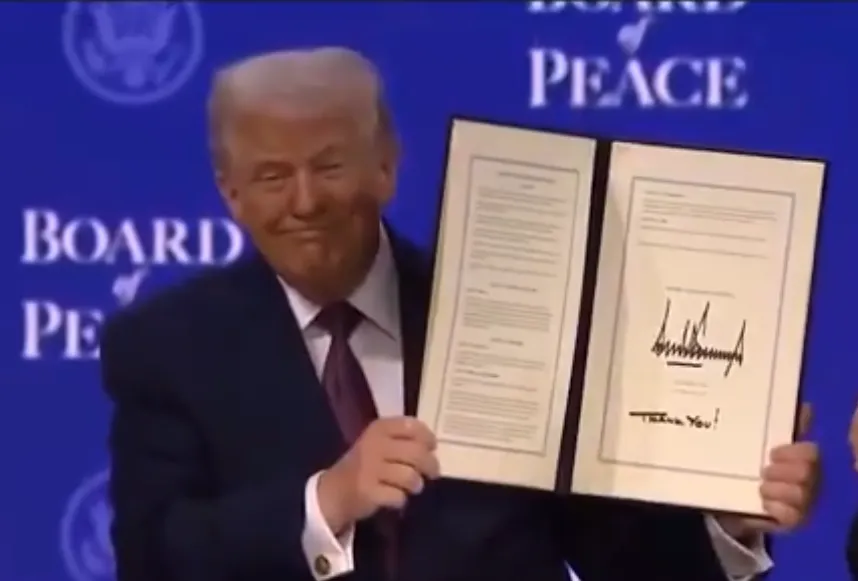
At the World Economic Forum in Davos, the Trump peace charter WEF moment took center stage as Donald Trump signed the newly announced Board of Peace Charter, unveiling a proposed global body for conflict resolution and international cooperation. Framed as a milestone in modern diplomacy, the Trump peace charter WEF signing was presented as a step toward structured peace-building, while immediately sparking debate over whether the initiative represents substantive global action or carefully timed political symbolism.
At the World Economic Forum in Davos, the Trump peace charter WEF announcement gained attention after the White House shared official posts on its X handle. The posts highlighted President Donald Trump’s role in launching the Board of Peace Charter. No detailed briefing has appeared on the WEF website so far. Still, the White House frames the Trump peace charter WEF move as part of a wider peace initiative. This framing has pushed the proposal into the global spotlight and sparked debate over its intent and impact.
What Is the Board of Peace Charter?
The Trump peace charter WEF moment centers on the formal establishment of a body designed to coordinate peace-oriented initiatives among governments, institutions, and non-state actors. On paper, its goals appear ambitious: fostering dialogue, preventing escalation, and supporting post-conflict stabilization.
However, global governance experts note that similar structures already exist within international institutions. From UN-led mediation frameworks to regional peace councils, the challenge historically has not been the absence of boards — but the lack of enforcement power and political will.
This raises a crucial question: does the Board of Peace represent innovation, or reinvention?
Timing, Optics, and Global Attention
Notably, the timing of the Trump peace charter WEF signing has fueled skepticism. Meanwhile, multiple global conflicts remain unresolved, and diplomatic tensions continue to rise across continents. As a result, the Davos stage offered maximum global visibility for the announcement.
For critics, this visibility is precisely the issue.
The Trump peace charter WEF moment focuses on the creation of a new body to coordinate peace efforts among governments, institutions, and non-state actors. On paper, its goals appear ambitious. However, they mainly include fostering dialogue, preventing escalation, and supporting post-conflict stabilization.
Supporters counter that visibility is not a flaw but a feature — that peace initiatives require attention, influence, and elite buy-in to succeed.
Substance vs. Symbolism in Global Peace Efforts
The debate surrounding the Trump peace charter WEF event reflects a deeper tension in international politics: the gap between symbolism and measurable outcomes.
History shows that peace charters and declarations often succeed in raising awareness but struggle to deliver results without enforcement mechanisms. Real peace, critics argue, is built through sustained negotiations, compromise, and accountability — not signatures alone.
That said, defenders insist that frameworks matter. They argue that every durable peace process begins with structure, and dismissing institutional efforts outright risks cynicism replacing diplomacy.
Why Davos Matters
Importantly, Davos is not a neutral backdrop. Instead, as the world’s most influential economic forum, it blends politics, finance, and global governance in a way few platforms can. Consequently, launching the Trump peace charter WEF initiative there ensures immediate buy-in from corporate leaders, policymakers, and international institutions.
But it also ties peace to elite consensus — a dynamic that has long drawn criticism from civil society groups who argue that peace cannot be engineered solely from boardrooms.
The Bigger Question: Will It Change Anything?
Ultimately, the success or failure of the Trump peace charter WEF initiative will not be determined by headlines or ceremonies, but by outcomes. Will mediation efforts produce results? Will the board act independently of political interests?
Until those answers emerge, the charter exists in a gray zone — part hope, part skepticism, and entirely subject to interpretation.
What is clear is that the world is watching.
FAQ
About the Author: GRV is a digital media writer who created Dumbfeed, a platform that simplifies complex global and political news into clear, engaging, and family-friendly formats. He delivers accurate, easy-to-understand explanations that help readers stay informed without the noise. When he’s not writing, GRV produces video content and short-form news updates for social media.