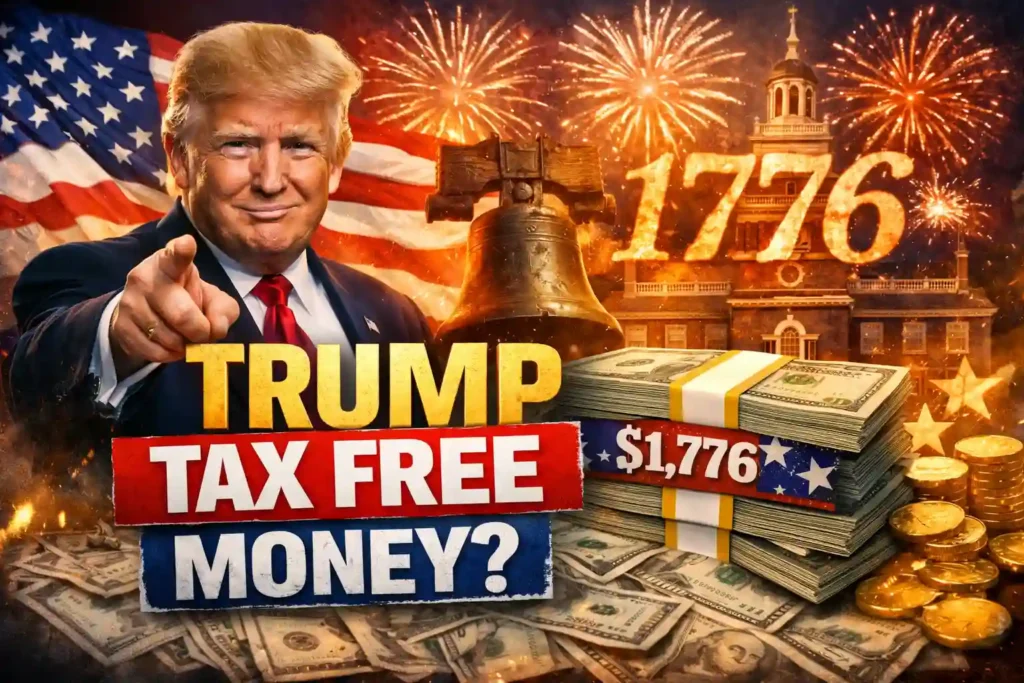
Trump tax free money became a major talking point after Donald Trump referenced a $1776 tax-free amount in a public address. He claimed recipients would not need to send any portion back to the government. Delivered around Christmas, the remark quickly drew attention. Its bold wording and use of “1776” sparked debate over whether it signaled real policy or political messaging.
Why the Number 1776 Matters in Trump Tax Free Money Rhetoric
The year 1776 marks American independence. Politicians often use it to symbolize freedom and resistance to excessive taxation. It also represents limited government control. By invoking this number, Trump’s tax free money comment reinforced themes he has emphasized for years. These include economic independence and opposition to what he calls government overreach.
Rather than presenting a detailed policy announcement, the statement leaned heavily on symbolism, connecting financial relief to the founding ideals of the country.
Is Tax-Free Money Actually Possible?
In the U.S., whether income or payments are tax-free depends entirely on how they are classified under federal law. Certain government payments, credits, or relief programs can be exempt from federal income tax depending on legislation and IRS rules.
For official context, the U.S. government released a news announcement explaining the $1,776 “Warrior Dividend” and distributed it to U.S. service members ahead of Christmas. According to the Department of War’s official website, the announcement presented the payment as a symbolic and morale-boosting dividend tied to the nation’s founding year, 1776. The release also explains how authorities structured and communicated the payment as a special distribution rather than a routine taxable benefit.
This context is important because Trump’s tax free money remark was not accompanied by a specific bill, executive order, or new IRS rule.
Trump Tax Free Money: Political Messaging and Public Reaction
Supporters interpreted Trump’s statement as a strong reaffirmation of his anti-tax stance and a promise of keeping more money in citizens’ hands. Critics, however, questioned whether the comment blurred the line between symbolic messaging and concrete policy.
Either way, the clip quickly gained traction online, reigniting debate over taxation, government spending, and the role of symbolism in modern political communication.
What Trump Really Meant
At its core, the $1776 reference focused less on policy and instead emphasized messaging. Moreover, Trump tax free money rhetoric relies heavily on historical symbolism. At the same time, it blends economic themes with emotion to connect with voters. As a result, this approach becomes especially effective during holidays and moments of national identity.
The comment fits into a broader pattern of messaging rather than serving as a standalone policy declaration.
FAQ
About the Author: GRV is a digital media writer and the creator of Dumbfeed, a platform dedicated to simplifying complex global and political news into clear, engaging, and family-friendly formats. He focuses on delivering accurate, easy-to-understand explanations that help readers stay informed without the noise. When he’s not writing, GRV creates video content and short-form news updates for social media.