Introduction: A Moment That Changed the Conversation
The Trump Venezuela comment did not come in a vacuum—it came at the exact moment when he was being pressed on one of the most serious geopolitical questions today: the conflict with Iran. What began as a direct question about war strategy quickly turned into an unexpected remark about Venezuela, shifting the entire narrative—and possibly, the public’s attention. The moment was brief, almost absurd. But in geopolitics, such moments often reveal more than they conceal.
Background: A War Without a Clear Script
The United States is currently entangled in a volatile confrontation with Iran. Military operations, diplomatic ambiguity, and conflicting narratives have defined the situation. Recent developments suggest a fragile ceasefire, though even that remains contested. Reports indicate inconsistencies between U.S. claims and ground realities, raising questions about strategic coherence.
At the same time, domestic pressure is mounting. Lawmakers have attempted—unsuccessfully—to limit presidential war powers, highlighting concerns over unchecked escalation. In this context, the expectation from leadership is simple: clarity. Instead, the conversation took a different turn.
To understand how the moment unfolded in real time, viewers can watch the full press conference on the Official White House Page.
The Moment: When Iran Became Venezuela
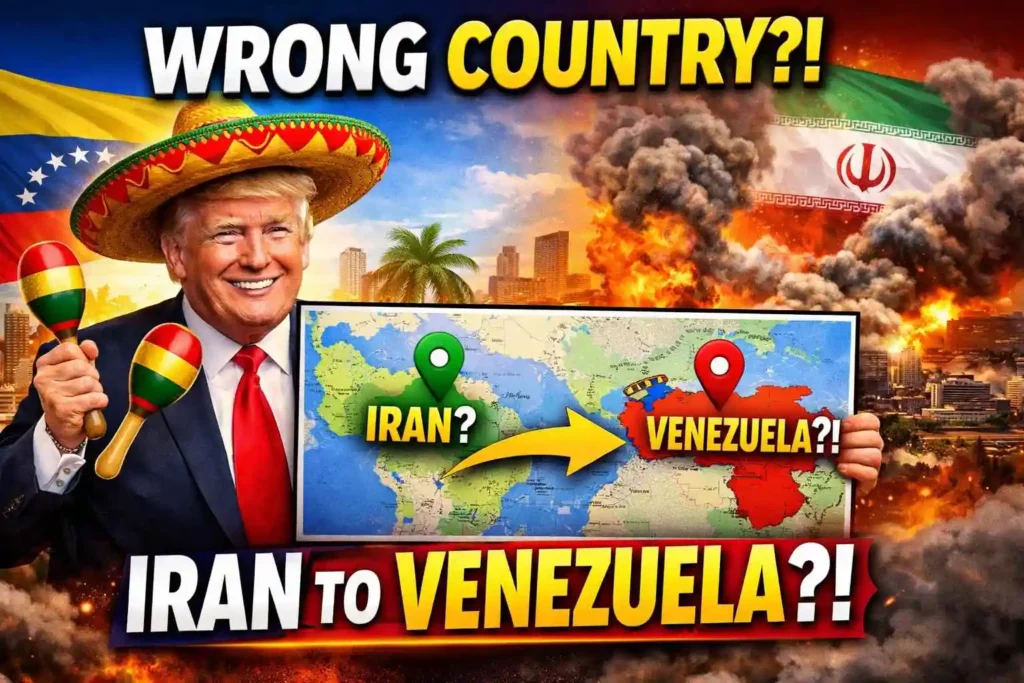
During a press briefing focused on Iran, Trump joked about becoming president of Venezuela, even suggesting he might learn Spanish and run in its elections. On the surface, it appeared to be a throwaway line—another instance of political humor. But its impact was immediate.
Media coverage shifted. Social media amplified the remark. And the original question—about U.S. strategy in Iran—faded into the background. This is where the significance lies.
Analysis: Distraction, Strategy, or Both?
The “Trump Venezuela comment” can be interpreted in multiple ways, but one pattern stands out: narrative control.
1. The Power of Distraction
In high-pressure environments, unexpected statements can redirect attention. By introducing an unrelated but provocative topic, the focus shifts away from difficult questions. In this case, the Iran strategy—already criticized as unclear—was no longer the headline.
2. Political Communication as Performance
Modern political communication often blends governance with spectacle. Trump’s style has consistently leaned toward this approach—using humor, exaggeration, and unpredictability to dominate media cycles. This is not accidental. In a fragmented media landscape, attention is currency.
3. The “Escalation Trap”
Strategically, the U.S. faces a dilemma in Iran:
- Escalate military action and risk regional war
- De-escalate and appear weak
- Maintain current operations without clear objectives
None of these options offer a clean outcome. Analysts describe this as an “escalation trap”—a situation where every move carries significant risk. In such a scenario, ambiguity may not be a weakness—it may be a tactic.
Meanwhile: Why Venezuela Matters
The irony of the moment is that Venezuela is not entirely unrelated. The country is facing its own crisis, centered around its state oil company, PDVSA. Years of corruption, sanctions, and economic decline have weakened its position. Recent developments indicate:
- Increasing U.S. interest in Venezuelan oil markets
- Internal political struggles over control of resources
- The use of unconventional mechanisms, including crypto, to bypass sanctions
Control over oil remains central to global power dynamics. And Venezuela, despite its instability, holds some of the world’s largest reserves. In that sense, the reference may have been more than a joke—it may have hinted at broader strategic interests.
Global Implications: A Fragmented World Order
The shift in narrative reflects a deeper issue: fragmentation in global politics.
1. Strained Alliances
Tensions with NATO allies have increased, with some countries refusing to support U.S. actions in Iran.
This signals a weakening of traditional alliances.
2. Conflicting Objectives
While the U.S. claims progress in Iran, Tehran continues to assert its strategic autonomy. The lack of a unified narrative complicates diplomacy.
3. Expanding Geopolitical Scope
From the Middle East to Latin America, U.S. foreign policy appears increasingly interconnected. Actions in one region influence dynamics in another. This raises a critical question: Is this a coordinated global strategy—or a series of reactive moves?
Conclusion: The Question That Remains
The Venezuela remark may have been humorous. But its consequences were not.
It shifted the conversation.
It redirected attention.
And it left key questions unanswered.
What is the objective in Iran?
What defines success?
And how does this conflict end?
Until those questions are addressed, moments like these will continue to dominate the narrative—not because they matter more, but because they are easier to understand.