
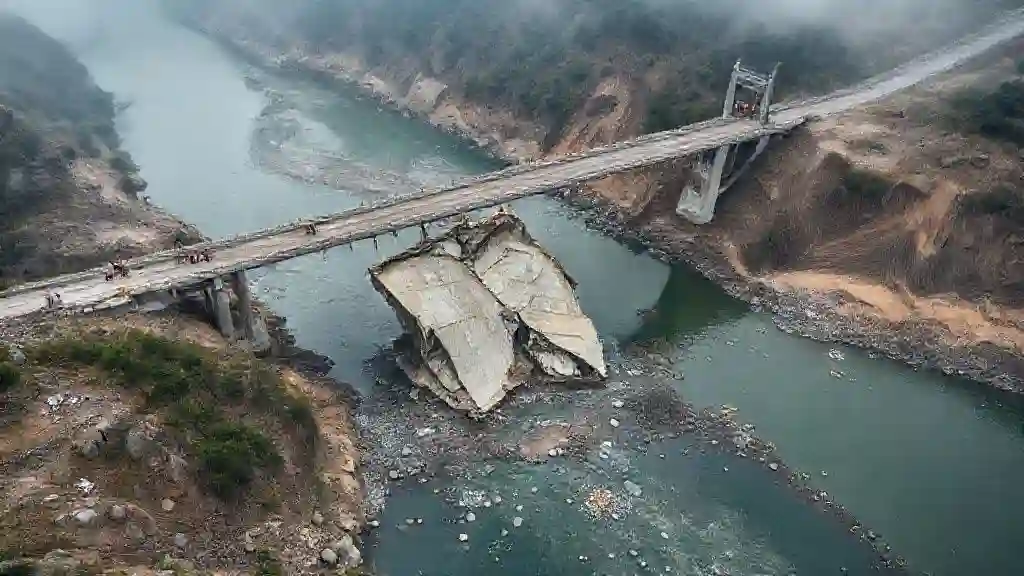
The Hongqi Bridge in Maerkang City, Sichuan Province, stood as a symbol of modern infrastructure designed to connect central China with Tibet. Stretching over 758 meters, it promised faster travel through one of the country’s most challenging terrains. Yet, only a few months after its opening, that promise literally collapsed. A massive landslide ripped apart part of the bridge, shocking engineers and citizens across China.
A Sudden Hongqi Bridge Collapse After Early Warning Signs
A day before the incident, authorities closed the Hongqi Bridge when cracks appeared on nearby slopes and the road surface. Local engineers noticed soil shifts and growing fissures in the mountainside. They decided to halt traffic to prevent possible danger. Their quick decision likely saved many lives, as the bridge section collapsed the next afternoon.
Videos circulating online showed concrete slabs sinking into the river as nearby slopes caved in. Rescue teams and structural engineers reached the scene soon after. They found that a section of the approach road and part of the bridge deck had been destroyed.
No Lives Lost, But Safety Questions Arise
Officials confirmed that no casualties occurred because the area was closed in time. Still, the Hongqi Bridge collapse raised serious questions. How could a newly constructed structure fail so soon? Why was the surrounding terrain not stabilized more effectively? Many residents in Sichuan expressed concern about other recent construction projects in mountainous areas.
Government inspectors have already begun an on-site review. They aim to determine whether construction quality, design flaws, or unstable geology played the main role. Early evidence suggests geological instability was the main cause, but experts say oversight and rushed work might have made the situation worse.
Geological Instability Behind the Hongqi Bridge in a High-Risk Region
The Hongqi Bridge stands in a region known for landslides and shifting mountain soil. The Sichuan-Tibet corridor has complex geological conditions that change with rainfall and temperature. Heavy rains in recent weeks softened the slopes around the bridge, triggering soil movements. The tension between the ground and the supporting structures eventually became too high, causing the slope to collapse.
Experts from the China Geological Institute noted that building in mountainous terrain requires long-term slope monitoring. Without regular geological updates, small shifts can lead to catastrophic damage. The Hongqi Bridge collapse might become a case study in how local terrain conditions can overpower even modern engineering.
Public Reaction and Growing Scrutiny
Public reactions online have been intense. Many people questioned why a bridge that opened only months ago could fail so quickly. Some social media users blamed construction shortcuts, while others pointed out that Sichuan’s landscape often hides deep, unstable fault lines that are hard to predict.
China’s Ministry of Transport has promised a transparent investigation. It has also sent engineers to inspect similar bridges across the province. The government aims to prevent similar incidents by introducing stricter inspection procedures for high-altitude infrastructure.
The Economic and Logistical Impact
The collapse of the Hongqi Bridge has also disrupted a vital route linking Sichuan to Tibet. The road supported trade, tourism, and supply transport for nearby regions. Local businesses now face delays as authorities reroute vehicles through longer mountain roads. This disruption could affect regional commerce for weeks.
Meanwhile, rebuilding efforts are expected to cost millions of yuan. Engineers will have to stabilize the slopes and reconstruct the bridge section, a process that could take several months.
Engineering Lessons from the Hongqi Bridge Collapse
The incident serves as a wake-up call for China’s infrastructure boom. Rapid development often comes with pressure to deliver projects quickly, especially in remote areas. The Hongqi Bridge collapse shows that geological risk analysis must receive equal importance as construction speed.
Future projects should combine advanced slope monitoring systems with real-time data analysis. Modern technologies like ground-penetrating radar and satellite imaging can detect micro-movements before visible cracks appear. Experts say these tools could have helped detect deeper weaknesses under the Hongqi Bridge.
A Reminder About Balancing Progress and Caution
The story of the Hongqi Bridge is both tragic and instructive. While no lives were lost, the failure revealed weaknesses in the way modern infrastructure interacts with nature. It reminds us that engineering precision cannot ignore environmental realities. As China continues to expand westward, planners must balance progress with patience.
The Hongqi Bridge collapse stands as a lesson on the need for consistent monitoring, better geological modeling, and long-term maintenance over quick construction timelines. In a landscape as dynamic as Sichuan’s, the price of ignoring those lessons can be devastating.
Source: CJ Sina
For more on current events, check out our full coverage on The Significance of Shai Hope Centuries in Modern ODI Cricket and stay updated on the latest developments.