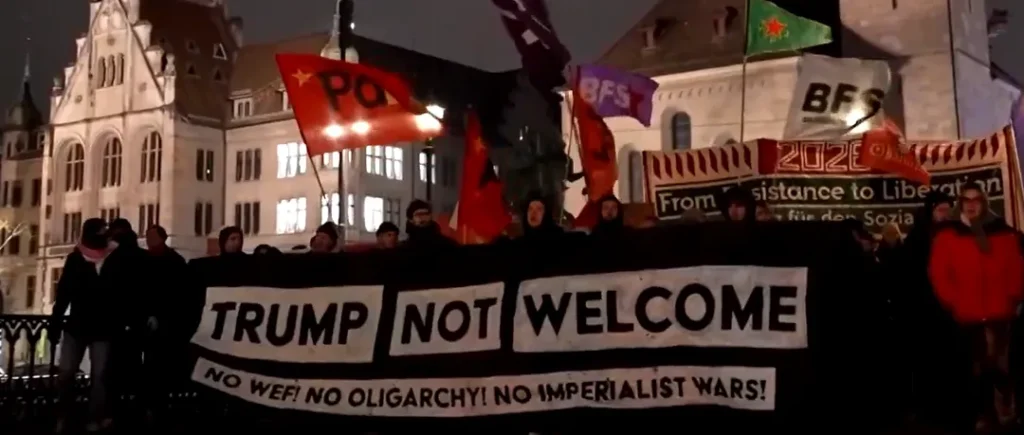
The World Economic Forum is once again under intense scrutiny as protests erupted in Davos, Switzerland, with demonstrators voicing opposition to elite-driven global policymaking and the participation of former U.S. President Donald Trump. As leaders, CEOs, and policymakers gathered behind closed doors, the streets outside became a stage for public anger over inequality, political power, and accountability.
The annual meeting of the World Economic Forum, long criticized as an exclusive gathering of global elites, has historically attracted protest movements. This year, however, tensions escalated sharply due to Trump’s appearance and ongoing geopolitical strains, including trade disputes and NATO-related concerns.
Why Protesters Are Targeting the World Economic Forum
At the heart of the demonstrations lies a growing distrust of the World Economic Forum and its influence over global economic and political decisions. Protesters argue that while the WEF promotes dialogue on climate change, inequality, and global cooperation, its closed-door nature excludes ordinary citizens from meaningful participation.
Activist groups argue that the World Economic Forum amplifies corporate and elite interests. They say it fails to address rising living costs, wage stagnation, and democratic erosion. Chants and placards in Davos accused the forum of shaping policies that affect billions without enough transparency or accountability.
According to Euronews, hundreds of demonstrators gathered in Davos to protest the World Economic Forum and the presence of Donald Trump. Protesters criticized elite power structures and inequality in global decision-making. The footage shows organized demonstrations outside the summit venue, with participants carrying signs and chanting slogans about political and economic influence.
Donald Trump’s Presence Intensifies the Backlash
The involvement of Donald Trump significantly amplified protest sentiment. Demonstrators linked Trump’s political legacy to concerns over nationalism, trade protectionism, and strained international alliances. His return to the global stage at the World Economic Forum was seen by critics as emblematic of elite rehabilitation rather than accountability.
Placards and chants directly referenced Trump’s past policies, including tariff threats and controversial foreign policy positions. For many protesters, his presence at Davos symbolized the convergence of political power and elite privilege — precisely what they oppose.
The backlash highlights how the World Economic Forum has become not just an economic summit, but a political lightning rod where global frustrations converge.
Davos: A Symbol of Elite Power
The town of Davos has long been synonymous with global influence. Each year, it transforms into one of the most heavily secured locations in Europe, hosting heads of state, billionaires, and institutional leaders.
For critics, Davos represents both a physical and symbolic divide. Leaders debate global futures inside secured venues, while ordinary citizens face real-world consequences. This contrast reinforces the view that the World Economic Forum operates within an insulated bubble.
Protesters argue that meaningful discussions about inequality and democracy cannot occur without broader public inclusion.
A Broader Global Pattern of Discontent
The protests in Davos are part of a wider global trend of resistance against elite governance structures. From climate demonstrations to cost-of-living protests across Europe and North America, public dissatisfaction with concentrated power is growing.
The World Economic Forum, due to its visibility and influence, has become a focal point for this frustration. Critics do not oppose dialogue itself but question who controls it and whose voices are prioritized.
As global economic uncertainty continues, pressure on institutions like the World Economic Forum is likely to intensify.
What This Means for the World Economic Forum
While WEF officials maintain that the forum fosters cooperation and problem-solving, the recurring protests highlight a credibility challenge. Public trust, once lost, is difficult to rebuild — especially when decisions made in Davos have global consequences.
Overall, the protests send a clear message: legitimacy in global governance requires transparency, accountability, and broader representation. As a result, without addressing these concerns, the World Economic Forum may continue to face resistance both inside and outside Davos.
FAQ
About the Author: GRV is a digital media writer who created Dumbfeed, a platform that simplifies complex global and political news into clear, engaging, and family-friendly formats. He delivers accurate, easy-to-understand explanations that help readers stay informed without the noise. When he’s not writing, GRV produces video content and short-form news updates for social media.