
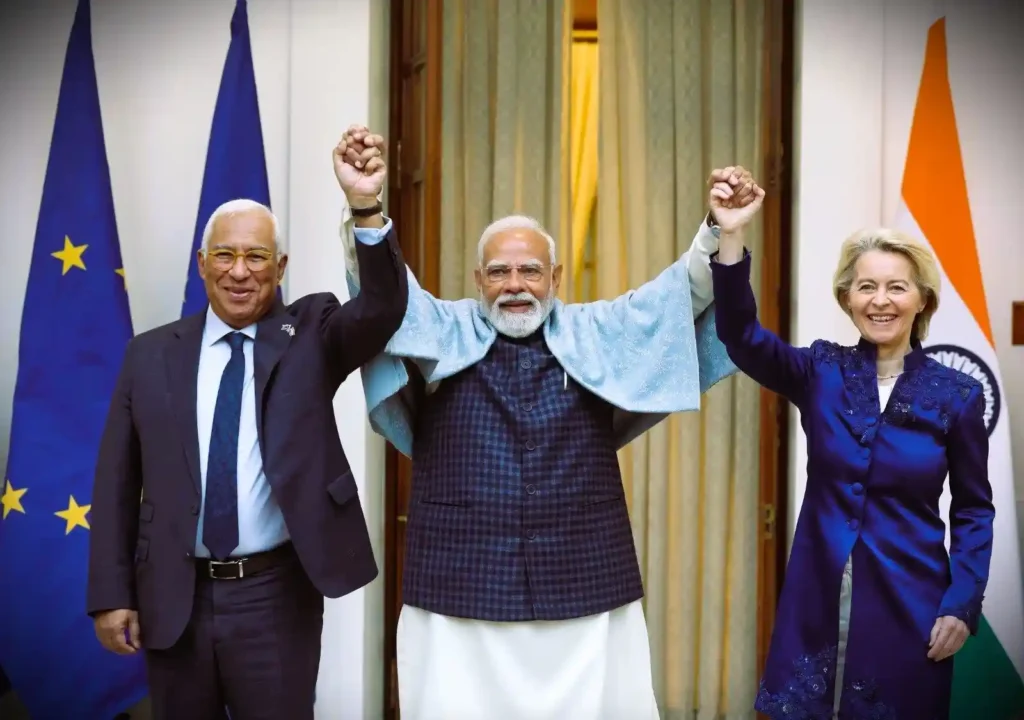
The India EU trade deal, often described by leaders as the “mother of all deals,” marks one of the most ambitious trade agreements India has ever negotiated. Covering nearly a quarter of global GDP, the India–EU Free Trade Agreement (FTA) aims to reshape trade flows, reduce tariffs across major industries, and deepen strategic ties between India and the European Union.
After years of stalled talks, both sides have now reached a political agreement, with formal ratification expected after legal and parliamentary processes. While the headlines celebrate the scale of the pact, the real story lies in how the India EU trade deal affects individual sectors — from automobiles and pharmaceuticals to agriculture and services.
This article breaks down the agreement sector by sector, explaining what changes, who benefits, and where concerns remain.
India EU Trade Deal: The Big Picture
The India EU trade deal seeks to reduce or eliminate tariffs on around 96–97% of goods traded between the two economies over a phased period. According to early estimates, the deal could save European exporters billions of euros annually while giving Indian manufacturers and service providers improved access to one of the world’s richest consumer markets.
In the meantime, official briefings and international reporting provide a detailed overview of the announcement and political agreement. Furthermore, European Union’s trade policy platform, confirms the conclusion of negotiations under the India EU trade deal and clearly outlines the agreement’s scope and long-term objectives.
While negotiators are still preparing the final legal text, the available details already clarify how the India EU trade deal is likely to impact key industries.
Automobiles and Auto Components
The automobile sector is one of the most talked-about elements of the India EU trade deal.
- The India EU trade deal sharply reduces import duties on European passenger cars—from levels as high as 110% to around 10% in some cases—under a quota-based system.
- Auto components and parts will see tariffs phased out over time.
Impact:
European automakers gain unprecedented access to India’s growing premium car market. For India, cheaper imports may increase competition, putting pressure on domestic manufacturers while also encouraging technology transfer and higher quality standards.
Alcohol, Wine, and Processed Food
Alcoholic beverages have long been a sticking point, and the India EU trade deal introduces significant changes.
- Wine tariffs, previously around 150%, will be reduced to roughly 20–30%.
- Spirits and beer will also see substantial duty cuts, though not complete elimination.
- Olive oil and certain processed foods are expected to see tariffs reduced to zero or near-zero levels.
Impact:
European exporters benefit immediately, while Indian consumers may see greater variety and lower prices. Domestic producers, however, could face increased competition, especially in premium segments.
Pharmaceuticals and Chemicals
Pharma and chemicals are critical sectors in the India EU trade deal.
- The India EU trade deal further reduces or fully eliminates tariffs on pharmaceutical products that were already relatively low.
- Chemical products will see duties phased out across a wide range of categories.
Impact:
Indian pharmaceutical exporters gain easier access to the EU market, but stricter regulatory and compliance standards may raise costs. European firms benefit from smoother access to India’s large healthcare market.
Machinery and Industrial Goods
Meanwhile, industrial machinery, electrical equipment, and capital goods continue to form a major portion of European Union exports to India.
- Tariffs that currently reach up to 40% or more will be largely eliminated.
- Customs procedures will be streamlined to reduce delays.
Impact:
Indian industries gain access to cheaper, high-quality European machinery, improving productivity. At the same time, domestic machinery manufacturers may face tougher competition from EU firms.
Textiles and Apparel
Textiles are a major export sector for India, and the India EU trade deal offers meaningful advantages.
- Duties on Indian textiles, garments, and footwear entering the EU will be reduced or removed.
- Rules of origin have been designed to support Indian manufacturers.
Impact:
This sector is one of the biggest winners for India, improving competitiveness against rivals like Bangladesh and Vietnam in European markets.
Aerospace and High-Tech Products
The agreement also covers aerospace components and advanced manufacturing.
- The agreement eliminates most tariffs on aircraft parts and high-tech equipment.
- Cooperation in technology and standards is expected to deepen.
Impact:
European aerospace firms benefit from easier access to India’s fast-growing aviation market, while India gains exposure to advanced manufacturing ecosystems.
Agriculture: What’s Protected and What’s Not
Agriculture remains a sensitive area in the India EU trade deal.
- India has largely protected sensitive items such as dairy, rice, wheat, sugar, and meat under the India EU trade deal.
- Limited tariff reductions apply to select agricultural products.
Impact:
India has safeguarded farmer interests, while the EU has accepted limited access in this politically sensitive sector.
Services and Mobility
Unlike goods, services liberalisation is more complex.
- The agreement improves access to financial services, maritime services, and professional services.
- Temporary mobility provisions may ease movement for skilled professionals, though details remain limited.
Impact:
India’s IT and professional services sector could benefit, but gains depend heavily on implementation and regulatory cooperation.
Why the India EU Trade Deal Matters
Beyond tariffs, the India EU trade deal is strategically significant. It signals deeper economic alignment at a time when global trade is fragmenting and protectionism is rising. For India, it strengthens integration with advanced economies. For the EU, it diversifies supply chains away from over-dependence on a single region.
FAQ
About the Author: GRV is a digital media writer who created Dumbfeed, a platform that simplifies complex global and political news into clear, engaging, and family-friendly formats. He delivers accurate, easy-to-understand explanations that help readers stay informed without the noise. When he’s not writing, GRV produces video content and short-form news updates for social media.