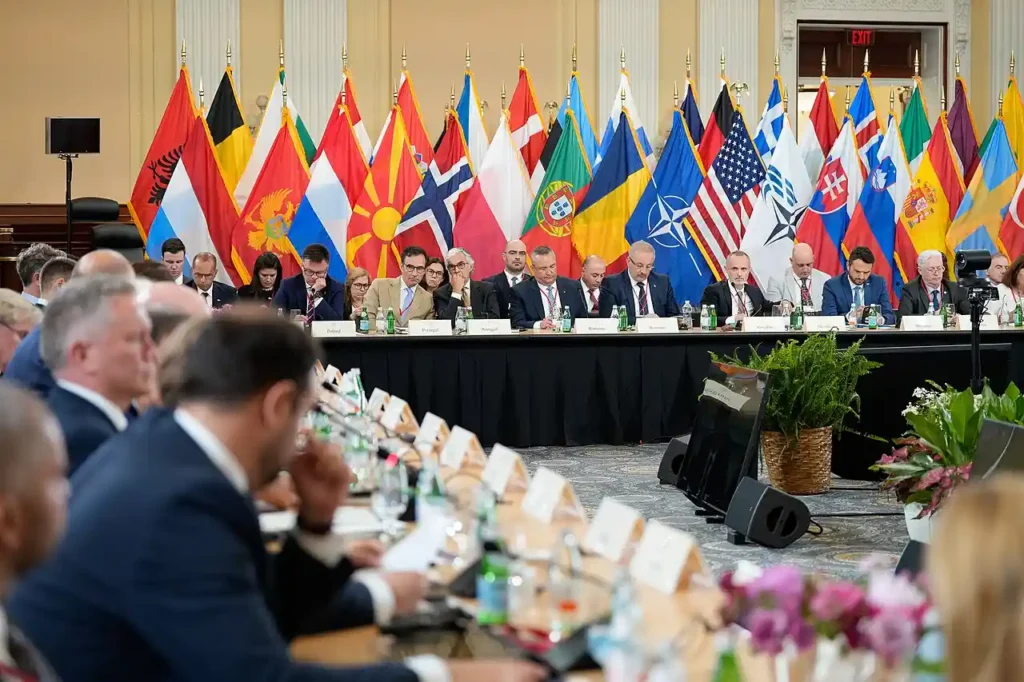
In an era of rising tensions, shifting alliances, and renewed great-power competition, the NATO global role has become central to global security. NATO is no longer just a Cold War alliance—it now actively shapes conflicts, diplomacy, and the balance of power worldwide. But in 2026, NATO is not simply defending borders—it is influencing how global power itself is structured and contested.
Background: Evolution of the NATO Global Role Since the Cold War
Formed in 1949, NATO was initially designed to counter the influence of the Soviet Union. Its core principle—collective defense under Article 5—ensures that an attack on one member is considered an attack on all.
Over time, the NATO global role expanded beyond its original Western bloc, incorporating Eastern European nations after the collapse of the Soviet Union. This evolution of the NATO global role has been a major source of geopolitical friction, particularly with Russia.
For a foundational understanding of NATO’s structure and mission, This is NATO’s updated official page and it explains their purpose, structure, and global role..
What’s critical today is that NATO has evolved far beyond its original mandate. It now engages in cybersecurity, counterterrorism, and even strategic deterrence in the Indo-Pacific.
Current Developments: NATO in a Changing World Order
In recent years, NATO’s global role has expanded significantly due to several key developments:
1. Rising Tensions with Russia
The ongoing confrontation between NATO and Russia has redefined European security. NATO has increased troop deployments in Eastern Europe, signaling a shift from deterrence to active readiness.
2. Expansion and Strategic Partnerships
NATO’s enlargement continues to reshape global alignments. New members and partnerships—particularly with countries like Sweden and Finland—have strengthened its northern flank.
3. Focus on China and the Indo-Pacific
While NATO remains Euro-Atlantic at its core, it has increasingly addressed China’s growing influence. Strategic discussions now include economic security, supply chains, and military posturing in Asia.
4. Technological Warfare and Cybersecurity
Modern conflicts are no longer limited to physical battlefields. NATO is investing heavily in cyber defense and emerging technologies, recognizing that future wars will be fought as much in cyberspace as on land.
Geopolitical Analysis of the NATO Global Role
NATO Global Role
NATO’s strength lies not just in military capability but in its ability to unify political will. With over 30 member states, it represents a significant portion of global military spending and technological capacity. This makes NATO a power multiplier—an entity that amplifies the influence of its members collectively.
Balancing vs Provoking Power
However, NATO’s expansion has sparked intense debate.
- Supporters argue that NATO stabilizes regions and deters aggression.
- Critics claim it provokes rival powers, particularly Russia, by encroaching on their perceived spheres of influence.
This duality is central to understanding the NATO global role: it is both a stabilizer and a source of tension.
The Strategic Signal to the World
NATO’s actions send powerful signals globally. Military exercises, troop deployments, and diplomatic statements influence not just adversaries but also neutral and allied nations.
For countries in Asia, Africa, and the Middle East, NATO’s posture often shapes their own strategic calculations.
Possible Global Consequences
1. A More Polarized World
As NATO strengthens, rival alliances may emerge or deepen. This could accelerate a shift toward a multipolar world, where blocs compete for influence.
2. Increased Risk of Proxy Conflicts
Rather than direct confrontation, global powers may engage in proxy wars—conflicts fought indirectly through smaller nations or regions.
3. Militarization of Emerging Domains
From space to cyberspace, NATO’s involvement could drive further militarization, raising concerns about escalation beyond traditional battlefields.
4. Economic and Political Ripple Effects
Sanctions, defense spending, and strategic alignments influenced by NATO decisions can have far-reaching economic consequences, affecting global markets and trade routes.
Conclusion: The Future of the NATO Global Role
NATO is no longer just a relic of the Cold War—it is a dynamic force shaping the present and future of global politics.
Its decisions influence not only military outcomes but also diplomatic strategies, economic policies, and technological competition. Whether seen as a stabilizing force or a catalyst for tension, NATO’s global role is undeniable.
As the world navigates an uncertain geopolitical landscape, one thing remains clear: understanding NATO is essential to understanding global power itself.