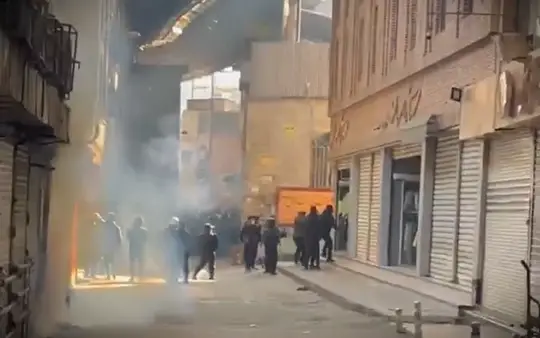
Tehran Bazaar clashes broke out as protests over rising prices and economic pressure intensified at the Tehran Grand Bazaar, one of the country’s most important commercial and symbolic centers.
According to international media reports, shopkeepers and citizens gathered inside the market to voice anger over inflation, currency depreciation, and declining purchasing power. As crowds grew, security forces moved in to prevent the demonstrations from spreading further. The situation escalated when tear gas was deployed in several corridors of the market, forcing many businesses to shut their doors abruptly.
Source: AP News
Footage shared on social media showed chaotic scenes, with shoppers fleeing enclosed alleys and security units positioning themselves at key entrances. While authorities have not released detailed casualty figures related specifically to the Bazaar, rights groups say nationwide unrest has led to numerous arrests in recent days.
Why the Tehran Bazaar Holds Special Significance
The Grand Bazaar has historically served as more than a trading center. It functions as an economic nerve center and a political barometer. During previous periods of unrest, including past protest movements, disruptions at the Bazaar often signaled broader dissatisfaction within society.
Merchants play a unique role in Iran’s economy. Many depend on daily trade to survive, leaving little room to absorb shocks from inflation or currency instability. When traders close shops in protest, the impact extends beyond symbolism, affecting supply chains, consumer confidence, and government revenue.
For this reason, Tehran Bazaar clashes carry weight far beyond the immediate confrontation between protesters and security forces.
Economic Pressures Behind the Protests
Iran’s economy has faced sustained pressure from inflation, currency volatility, and declining household purchasing power. In recent months, prices of essential goods have continued to rise, while wages have failed to keep pace.
Many Bazaar merchants say they can no longer operate predictably. Import costs fluctuate daily, customers are spending less, and savings lose value rapidly. Protesters argue that without meaningful economic relief, conditions will continue to deteriorate.
Analysts note that economic protests in Iran often begin quietly, centered on livelihoods rather than ideology. However, prolonged hardship has historically increased the risk of confrontations, particularly in dense urban spaces like major markets.
From Economic Protest to Street Confrontation
What began as frustration over prices evolved into direct confrontation once security forces attempted to disperse crowds. Witnesses described tense standoffs inside narrow Bazaar passageways, where even small clashes quickly escalated due to crowd density.
Authorities have emphasized the need to maintain public order, while urging citizens not to disrupt commercial activity. At the same time, the visible security presence has fueled criticism from demonstrators who view forceful dispersal as proof that economic grievances are being ignored.
The Tehran Bazaar clashes highlight the challenge facing officials: containing unrest without deepening public resentment.
Signs of Wider Unrest Across Iran
Events at the Bazaar reflect a broader pattern unfolding across the country. Protests tied to economic conditions have appeared in multiple cities, with demonstrators voicing concerns about inflation, unemployment, and declining living standards.
While not all demonstrations have turned confrontational, the scale and frequency suggest growing frustration. International observers say continued unrest at economically vital locations could increase pressure on decision-makers to respond with tangible reforms rather than short-term security measures.
What Comes Next
For now, security forces remain deployed in central Tehran, and authorities have promised to monitor the situation closely. Officials have reiterated commitments to economic adjustments, though specifics remain limited.
Whether the Tehran Bazaar clashes subside or evolve into a sustained protest movement will depend largely on economic developments in the coming weeks. Markets reopening fully, currency stabilization, and clear policy communication may help calm tensions. Without such steps, analysts warn that similar flashpoints could emerge elsewhere.
FAQ
About the Author: GRV is a digital media writer who created Dumbfeed, a platform that simplifies complex global and political news into clear, engaging, and family-friendly formats. He delivers accurate, easy-to-understand explanations that help readers stay informed without the noise. When he’s not writing, GRV produces video content and short-form news updates for social media.