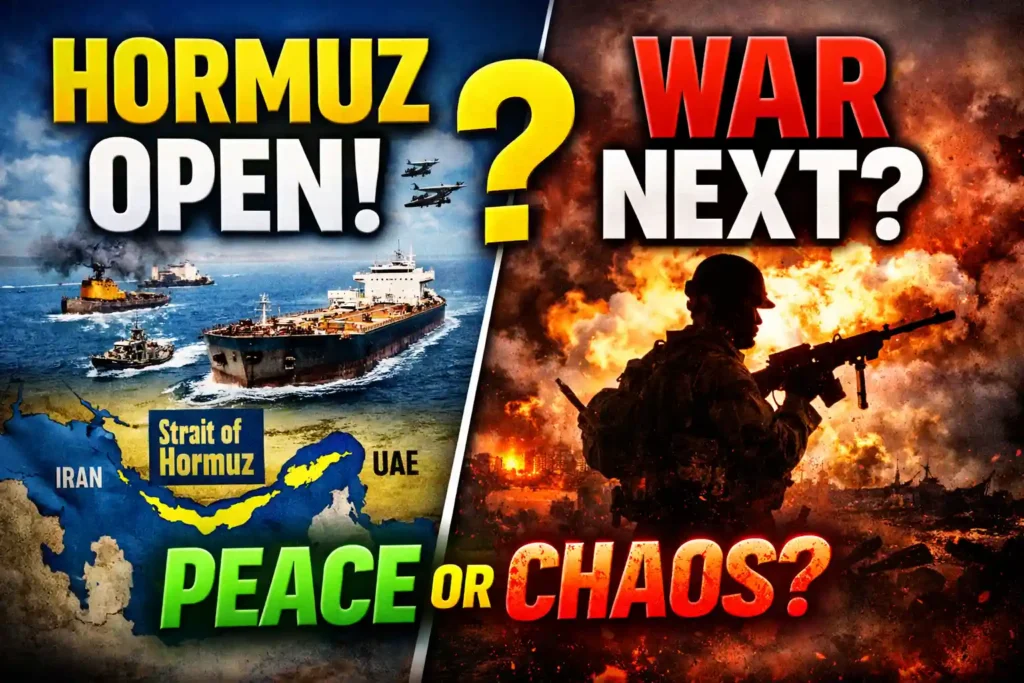
The Strait of Hormuz is open again. Oil is flowing, markets are stabilizing, and the immediate panic has faded. But geopolitics rarely rewards optimism this quickly. The real question is not whether tensions have eased — it’s whether the Strait of Hormuz crisis has actually been resolved, or merely postponed. Because in the Middle East, calm can be deceptive.
Background: Why the Strait of Hormuz Matters
The Strait of Hormuz is one of the world’s most critical energy chokepoints. Roughly a fifth of global oil supply passes through this narrow stretch of water connecting the Persian Gulf to international markets. When disruptions occur here, the consequences ripple globally — from rising fuel prices to stock market volatility and supply chain uncertainty.
For context on its strategic importance, see the U.S. Energy Information Administration’s overview.
This is why even the threat of closure during the recent Strait of Hormuz crisis triggered alarm across capitals and markets alike.
Current Developments: De-escalation by Declaration
Recent statements and diplomatic signaling — amplified by political messaging — suggest that passage through Hormuz is now fully open. Oil prices have responded quickly. Markets have climbed modestly. The narrative has shifted from imminent disruption to cautious relief. However, the nature of this de-escalation raises important questions. There has been no clear, verifiable agreement addressing the core issue at the heart of tensions: Iran’s nuclear ambitions and the broader regional rivalry with Israel.
Instead, what we are seeing appears to be a de-escalation by declaration, not by durable resolution. And that distinction matters.
The Deeper Fault Lines Remain
At the center of the Strait of Hormuz crisis lies a more fundamental conflict — not just between the United States and Iran, but between Israel and Iran. This distinction is critical.
Even if Washington and Tehran temporarily reduce tensions, Israel’s security calculus operates independently. If Israeli leadership perceives continued nuclear advancement by Iran, it retains both the capability and willingness to act. This creates a fragile equilibrium. Because any unilateral action — whether preemptive or retaliatory — could quickly unravel the current calm.
The Nuclear Question: Still Unresolved
The key issue remains unresolved: the status of Iran’s enriched uranium and its broader nuclear program. There has been no definitive confirmation, no transparent verification mechanism, and no clear pathway forward. In geopolitical terms, this ambiguity is not neutral — it is destabilizing.
Uncertainty breeds mistrust.
Mistrust increases the likelihood of miscalculation.
And in a region already defined by cycles of escalation, that is a dangerous combination.
Proxy Risks: The Most Immediate Threat
Even if direct confrontation is avoided, the risk of escalation through proxies remains high. Groups aligned with Iran, particularly in Lebanon and surrounding regions, operate in a gray zone — capable of initiating conflict without formal attribution.
This means that:
- A single rocket strike
- A limited cross-border incident
- Or even an isolated retaliation
could reignite hostilities.
Importantly, such incidents do not require large-scale coordination. They often emerge from fragmented decision-making on the ground. That makes them both unpredictable and difficult to contain.
The NATO Dimension: A Strategic Undercurrent
Recent rhetoric questioning NATO’s relevance adds another layer to the situation. While not directly tied to the Strait of Hormuz crisis, the implications are significant. A reduced U.S. commitment to NATO could signal a broader shift in strategic priorities — away from alliance-based security frameworks and toward more unilateral or region-specific approaches.
If such a shift materializes, it could lead to:
- Greater regional autonomy in conflict decisions
- Reduced coordination among Western allies
- Increased unpredictability in global crisis management
In short, the weakening of traditional alliances does not necessarily reduce conflict risk — it often redistributes it.
Possible Global Consequences
The reopening of the Strait of Hormuz has provided short-term relief. But the long-term outlook remains uncertain.
Several scenarios could unfold:
1. Fragile Stability
The current calm holds, tensions remain contained, and economic conditions stabilize. This is the most optimistic outcome — but also the least historically consistent.
2. Rapid Escalation
New intelligence or perceived threats trigger direct action, particularly involving Israel and Iran. In this scenario, escalation could occur with little warning and significant impact.
3. Proxy-Driven Conflict
Localized incidents expand into broader confrontation, drawing in multiple actors indirectly. This is often the most likely pathway in Middle Eastern conflicts.
4. Strategic Realignment
Shifts in U.S. foreign policy and alliance structures reshape the regional balance of power over time. This would not produce immediate conflict, but it could lay the groundwork for future instability.
Conclusion: Stability Without Resolution
The Strait of Hormuz is open. That much is clear. But the conditions that led to the Strait of Hormuz crisis have not been fundamentally resolved.
The nuclear issue remains uncertain.
Regional rivalries persist.
Proxy networks are still active.
What we are witnessing is not a resolution — it is a pause. And in a region where conflict often emerges from small, sudden triggers, pauses can be misleading. The appearance of stability should not be mistaken for its presence.