For decades, control over global chokepoints has shaped the balance of power. Now, the idea of a Malacca Strait strategy is gaining attention as the United States appears to shift its strategic focus from the Middle East to Southeast Asia.
As Washington deepens defense ties with Indonesia, analysts are increasingly asking whether this signals a broader geopolitical move—one that could redefine global trade security and intensify US–China rivalry.
Background: Why Chokepoints Matter
Global trade doesn’t just move—it flows through narrow, highly sensitive corridors. Among them, the Strait of Hormuz and the Strait of Malacca stand out as two of the most critical.
- The Strait of Hormuz has long been a focal point of US military presence due to its role in global oil supply.
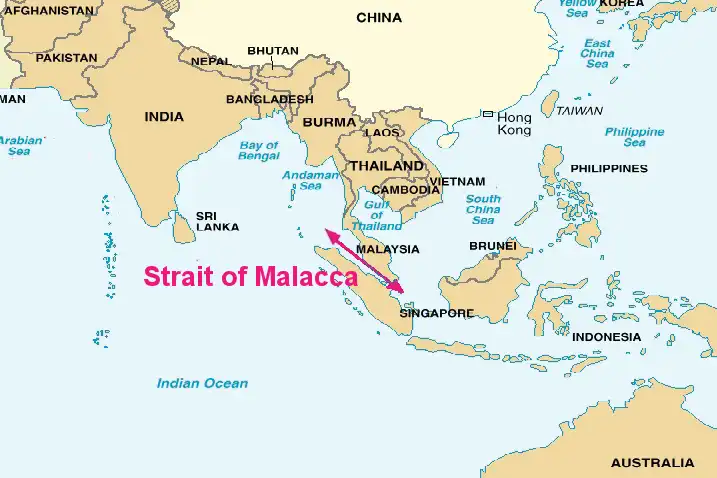
- The Strait of Malacca, however, carries nearly a quarter of global trade and serves as a vital artery for East Asia, particularly China.
For years, China has worried about what strategists call the “Malacca dilemma”—its heavy dependence on a route that could theoretically be disrupted during conflict.
The agreement focuses on military cooperation, training, and modernization, with no confirmed inclusion of overflight rights, according to a report by CNA.
Current Developments: US–Indonesia Alignment
Recent defense cooperation between the United States and Indonesia has drawn increasing attention.
The agreement, as publicly described, focuses on:
- joint military exercises
- capacity building
- defense modernization
However, reports suggesting expanded US access to Indonesian airspace—even if still under discussion—have triggered a wider debate. Indonesia, known for its non-aligned foreign policy, is carefully weighing the implications.
At the same time:
- China has signaled concern about growing US influence in the region
- Southeast Asia is becoming a more prominent arena in great power competition
While no formal plan exists to control or dominate the Strait of Malacca, the trajectory of engagement is enough to raise strategic questions.
Analysis: The Logic Behind a Malacca Strait Strategy
The idea of a Malacca Strait strategy is not about direct control—it’s about leverage.
1. Strategic Positioning, Not Occupation
Unlike traditional military dominance, modern geopolitical strategy often relies on:
- access
- partnerships
- rapid deployment capability
By strengthening ties with Indonesia, the US could:
- enhance surveillance capabilities
- improve logistical reach
- position itself closer to key maritime routes
This does not equate to “control,” but it significantly increases strategic influence.
2. A Shift from Hormuz to Indo-Pacific?
Historically, US strategy has prioritized the Middle East, particularly the Strait of Hormuz. But recent developments suggest a gradual pivot:
- Greater emphasis on the Indo-Pacific
- Increased military cooperation with regional partners
- Focus on counterbalancing China’s rise
Seen through this lens, the Malacca Strait becomes not just a trade route—but a geopolitical pressure point.
3. The “Pattern” Argument
Some analysts interpret recent US foreign policy moves as part of a broader strategic mindset—one that emphasizes:
- expanding influence
- securing critical regions
- pre-positioning assets
While there is no formal doctrine stating this, discussions around regions like Greenland in past years have contributed to a perception of assertive geopolitical thinking.
Applied here, the argument is simple:
If chokepoints define power, then positioning near them defines future dominance.
Global Implications
If a Malacca-focused strategy continues to develop, the consequences could extend far beyond Southeast Asia.
1. Increased US–China Tensions
China’s economy depends heavily on maritime trade passing through Malacca. Any perception of US leverage over this route could:
- heighten security concerns in Beijing
- accelerate China’s push for alternative routes (e.g., Belt and Road corridors)
- increase military presence in nearby waters
2. Pressure on ASEAN Neutrality
Countries like Indonesia, Malaysia, and Singapore have traditionally avoided aligning too closely with major powers.
However:
- deeper US involvement may force difficult diplomatic choices
- regional unity could be tested
- balancing acts may become harder to sustain
3. Risk to Global Trade Stability
The Strait of Malacca is not just a regional asset—it is a global economic lifeline.
Any escalation in tensions could:
- disrupt shipping routes
- increase insurance and logistics costs
- impact energy and goods supply chains worldwide
4. Strategic Ripple Effects
A stronger US presence near Malacca could influence:
- Taiwan contingency planning
- South China Sea dynamics
- India’s role in Indo-Pacific security
In short, this is not an isolated development—it is part of a larger strategic puzzle.
Conclusion
The emerging discussion around a Malacca Strait strategy reflects a deeper transformation in global geopolitics. While there is no confirmed plan for control or domination, the direction of US policy—toward greater presence and partnerships in Southeast Asia—suggests a long-term strategic calculation.
From Hormuz to Malacca, the logic remains consistent:
Control the chokepoints, and you shape the flow of global power.
Whether this evolves into a defining feature of US strategy—or remains a cautious balancing act—will depend on how regional players respond, and how far great power competition is willing to go.