
The U.S. dollar falling has become one of the biggest economic stories of 2026. Long considered the backbone of global finance and the world’s primary reserve currency, the dollar is now facing notable downward pressure. Investors, policymakers, and businesses are closely watching the trend because movements in the dollar influence everything from inflation and trade to investment flows and geopolitical stability.
Recent market data shows that the dollar has dropped to a four-year low against a basket of major currencies; as a result, it reflects declining confidence and, more importantly, signals growing uncertainty in the global economic environment.
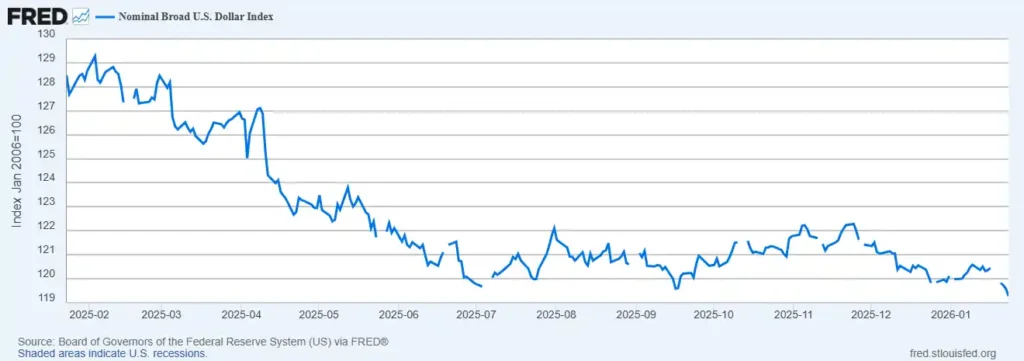
According to the Federal Reserve’s Nominal Broad U.S. Dollar Index, which tracks the dollar against major trading partners, the currency has recently shown periods of noticeable weakness, thereby reflecting shifting investor sentiment and, at the same time, signaling evolving global economic conditions.
But what is really driving the U.S. dollar falling trend? Is it global tension, trade wars, debt, or investors shifting toward gold? The answer lies in a combination of structural and short-term forces reshaping the financial landscape.
A Sharp Decline Amid Economic and Political Uncertainty
The dollar has already fallen about 9% during 2025 and continued declining into early 2026, with the dollar index dropping to its lowest level since 2022.
Experts point to several overlapping concerns:
- Persistent fiscal deficits
- Threats to central bank independence
- Volatile trade policy
- Investor worries about economic stability
Together, these factors have weakened confidence in U.S. assets and reduced demand for the currency. When investors begin questioning a country’s economic direction, capital often moves elsewhere — and currencies respond quickly.
Interest Rates Are a Major Driver
One of the most direct reasons behind the U.S. dollar falling is the outlook for interest rates. Lower rates typically reduce returns on government bonds and other dollar-denominated investments, making them less attractive compared to opportunities abroad.
Meanwhile, some foreign central banks have maintained relatively higher rates, encouraging capital to flow into Europe and Asia instead of the United States. Currency markets are highly sensitive to yield differences. Even small shifts can trigger massive portfolio reallocations by institutional investors.
Rising Debt and Fiscal Pressure
Another structural issue weighing on the dollar is America’s expanding debt burden. The U.S. national debt has already crossed $35 trillion, raising concerns about borrowing levels, inflation risks, and long-term financial sustainability.
High debt signals that governments may need to issue more bonds or increase money supply — both of which can dilute currency value over time. When investors fear a country may struggle to manage its debt responsibly, they often diversify into other currencies or assets, reducing demand for the dollar.
Trade Policy and Tariff Uncertainty
Trade strategy also plays a role in the U.S. dollar falling narrative. Analysts say that stop-start tariff wars, vast borrowing needs, and worries about the independence of the Federal Reserve have undermined the dollar’s appeal as a safe-haven asset; as a result, investors are becoming more cautious.
Additionally, tariff threats — even against traditional allies — have contributed to market volatility and investor caution. While tariffs do not directly weaken a currency, they influence economic growth expectations, corporate earnings, and capital flows.
Political Signals and Market Sentiment
Currency markets are not driven purely by data — perception matters. The dollar recently dropped after markets reacted negatively to political messaging and policy unpredictability, contributing to one of the steepest single-day losses in months. Analysts increasingly warn that political interference concerns and erratic policy decisions could trigger further declines if uncertainty persists. Simply put, confidence is currency.
Investors Are Moving Toward Gold and Hard Assets
As the U.S. dollar falling trend accelerates, investors are reallocating capital into perceived safe havens. Gold prices have surged to record highs amid heightened political and economic uncertainty, highlighting a classic defensive strategy during currency weakness.
Additionally, global capital is shifting toward non-U.S. equities and hard assets, reflecting what some analysts describe as a growing “Sell America” sentiment in financial markets. This does not mean the dollar is losing reserve status overnight — but it suggests diversification is increasing.
Is De-Dollarization Finally Happening?
The idea of “de-dollarization” — reducing reliance on the U.S. currency — has gained traction in recent years. While the dollar remains dominant, investors now require greater foreign-exchange hedging for U.S. assets, which has prevented the currency from rallying even during equity rebounds.
Many analysts believe the current trend reflects a rebalancing of global capital, not an immediate collapse of the dollar system.
A Falling Dollar Isn’t Entirely Bad
Interestingly, currency weakness has winners as well as losers.
A softer dollar can:
- Boost multinational earnings when foreign revenues convert into more dollars
- Make U.S. exports more competitive
- Support corporate profits abroad
However, it can also:
- Increase import prices
- Raise inflation risks
- Reduce purchasing power for consumers
The broader economic impact depends on how long the trend persists.
What Happens Next?
Some forecasts suggest downward pressure could continue, with research estimating the currency might lose additional value by the end of 2026. Yet history shows currency cycles are rarely linear. Markets often overshoot before stabilizing.
The future path of the U.S. dollar falling will largely depend on:
- Federal Reserve policy
- Inflation trajectory
- Fiscal discipline
- Global growth patterns
- Geopolitical developments
If confidence returns, the dollar could recover. If uncertainty deepens, weakness may persist.
Final Thoughts
The U.S. dollar falling in 2026 is not the result of a single crisis but rather a convergence of economic, political, and structural forces. Lower interest-rate expectations, rising debt, trade tensions, policy uncertainty, and shifting investor behavior are all contributing to the currency’s decline. However, it is important to keep perspective: the dollar still anchors global trade and finance. What we are likely witnessing is not the end of dollar dominance — but a recalibration of its strength in a rapidly evolving world economy.
For investors and observers alike, the key takeaway is simple: currency movements often signal deeper economic transitions. And right now, the world is paying attention.
FAQ
About the Author: GRV is a digital media writer who created Dumbfeed, a platform that simplifies complex global and political news into clear, engaging, and family-friendly formats. He delivers accurate, easy-to-understand explanations that help readers stay informed without the noise. When he’s not writing, GRV produces video content and short-form news updates for social media.