Introduction: A Silent Battle on the High Seas
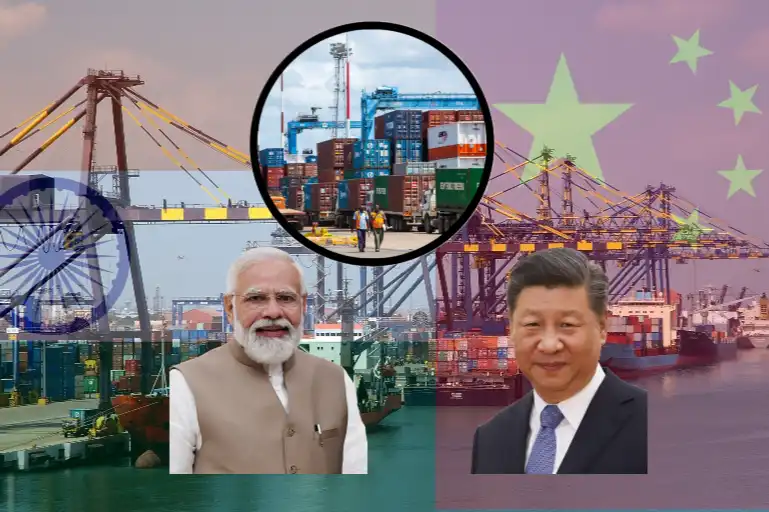
The next major global power rivalry is expanding beyond borders and airspace. It is now unfolding through ports, shipping lanes, and maritime infrastructure. The growing competition over India China ports is reshaping global trade networks and strategic influence.
Across the Indian Ocean, many countries are reconsidering their dependence on Chinese-operated ports. India is emerging as an alternative maritime partner with expanding logistics and port capabilities. According to Hindustan Times, diversified port networks are becoming essential for global supply chain resilience worldwide.
To know more about maritime strategy, read the Hindustan Times
Background: China’s Port Expansion Strategy
Over the past two decades, China has aggressively expanded its global maritime footprint through large-scale infrastructure financing and long-term port leases. Under initiatives linked to the Belt and Road Initiative, Chinese firms have invested in or operated over 100 ports across more than 60 countries, spanning Asia, Africa, and Europe. Major strategic investments include ports in Pakistan, Djibouti, Greece, and several West African coastal states. In many cases, these projects involved multi-billion-dollar funding packages, often structured through long-term concession agreements ranging from 25 to 99 years.
Critics argue that China’s port expansion is not entirely commercial. Several countries have raised concerns over rising service fees and growing debt dependency. China’s strategy often combines large infrastructure investments with long-term operational control, giving Beijing influence over key global shipping routes linked to more than 30% of major trade corridors. As a result, debates over sovereignty risks and geopolitical influence have intensified worldwide.
India’s Strategic Maritime Push
India, long considered a regional maritime player, is now expanding its global port strategy with renewed urgency. Unlike China, India promotes partnership-based port development instead of debt-heavy infrastructure financing. India is modernizing major domestic ports under the Make in India initiative, Mundra, JNPT, and Vizhinjam handle a major share of India’s cargo traffic. India’s ports support over 2,600 million tonnes of annual cargo capacity, India is expanding shipping connectivity across Asia, Africa, and the Middle East. The country has signed more than 200 bilateral maritime and trade agreements.
A major shift is visible in how countries perceive Indian port services. Nations such as Oman, Bangladesh, Sri Lanka, and several East African states are increasingly exploring Indian partnerships due to:
- Lower operational costs (often 15–25% more competitive in select routes compared to alternative hubs)
- Transparent trade policies
- Less political conditionality
- Faster port turnaround efficiency, with some Indian ports improving vessel handling time by 20–30% in recent years
India is investing over $80 billion in port modernization, digital logistics, AI cargo tracking, and green maritime technologies. These upgrades aim to strengthen India’s global shipping competitiveness and position the country as a reliable Indo-Pacific maritime hub capable of challenging Chinese-controlled logistics networks.
China’s Port Dominance Under Pressure
China’s port dominance, once driven by rapid expansion and massive infrastructure investments, is now facing increasing global scrutiny. Several countries are renegotiating agreements or diversifying partnerships due to debt concerns, sovereignty issues, and rising operational costs, which have slowed some Chinese port expansion projects.
At the same time, global shipping companies handling nearly 80% of world trade by volume are increasingly prioritizing route flexibility, cost efficiency, and political neutrality. This shift is gradually reducing the appeal of heavily centralized port control models. As a result, China’s expansion pace has moderated compared to the early Belt and Road phase, while alternative maritime hubs, including India, are gaining strategic visibility in global shipping networks.
Geopolitical Implications: A Maritime Cold War
The competition between India and China in ports is not just economic, it is deeply geopolitical. Ports today influence access to naval power projection, energy security routes, and global supply chains that carry nearly 80–90% of global trade by volume. Control over strategic ports directly impacts influence across key Indo-Pacific corridors, which handle an estimated 40%+ of global maritime traffic annually.
India’s growing maritime security partnerships with countries such as Japan, France, and Australia, through trilateral and quadrilateral frameworks, have strengthened its Indo-Pacific footprint across more than 12+ strategic naval cooperation exercises annually. Meanwhile, China maintains a strong naval-commercial hybrid presence across critical chokepoints including the South China Sea, Strait of Malacca, and the Indian Ocean, with over 30+ overseas logistical and port-linked facilities supporting its maritime reach. This evolving rivalry is increasingly described by analysts as a “maritime cold war,” where infrastructure control is becoming as critical as military dominance.
Global Consequences of the Port Rivalry
The shift in India China ports competition could reshape global trade in several ways:
1. Diversified Supply Chains
Countries may reduce overreliance on Chinese-controlled ports, leading to more balanced global logistics networks.
2. Rising Indo-Pacific Influence
India’s growing maritime footprint strengthens the strategic importance of the Indian Ocean region.
3. Competitive Port Pricing
Increased competition may lower shipping and handling costs globally.
4. Strategic Realignments
Smaller nations may adopt multi-partner port strategies to avoid overdependence on any single power.
5. Infrastructure Diplomacy Shift
Global influence may increasingly depend on who builds and operates ports rather than traditional military presence alone.
Conclusion: A New Maritime Balance Emerging
The contest over global ports is no longer a quiet economic story, it is a defining geopolitical shift. As India expands its maritime capabilities and China recalibrates its global port strategy, the balance of influence across key shipping routes is slowly evolving. The India China ports rivalry represents more than infrastructure competition; it signals a broader transformation in how global power is structured in the 21st century. The winner of this maritime contest may not only control trade routes but also shape the future of global economic connectivity.
By Sahil Koul | Geopolitical Analyst