Introduction
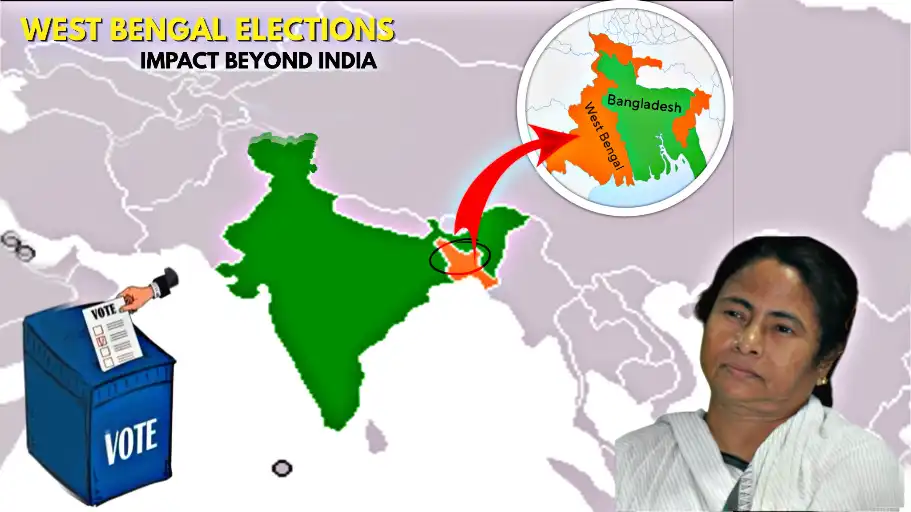
Elections in West Bengal rarely stay confined within state borders but this time, the stakes feel even higher. The latest mandate is not just about governance in Kolkata; it may ripple across Eastern India and into neighboring Bangladesh, influencing diplomacy, trade, and regional stability. The West Bengal election impact is emerging as a critical geopolitical story, one that could redefine how India engages with its eastern frontier.
Background: A Politically Charged State at a Strategic Crossroads
West Bengal has long been one of India’s most politically dynamic states, with a history of ideological shifts from decades of Left rule to the rise of regional dominance. Its geographic location makes it uniquely significant: it shares a long and porous border with Bangladesh and serves as a gateway to India’s Northeast. Before this election, the state faced multiple challenges:
- Sluggish industrial growth compared to western India
- Persistent political polarization
- Concerns over unemployment and investment climate
- Strategic underutilization of its ports and trade corridors
At the same time, West Bengal remained central to India’s “Act East Policy,” which aims to strengthen economic and strategic ties with Southeast Asia through eastern corridors.
For detailed election data and official updates, refer to the external source published by the Election Commission of India.
Current Developments: What the New Mandate Signals
The election results have delivered a clear political message, voters are seeking continuity in governance but also measurable development outcomes. This dual expectation places pressure on the state leadership to:
- Accelerate infrastructure development
- Improve investor confidence
- Strengthen administrative stability
- Align more effectively with central policies where beneficial
The political clarity provided by the mandate could reduce policy uncertainty, which has historically deterred large-scale investments in the region. More importantly, the result is being closely watched in Dhaka, where policymakers are assessing how the new political equation might affect bilateral cooperation.
India–Bangladesh Relations: A Delicate Balancing Act
One of the most immediate dimensions of the West Bengal election impact lies in India–Bangladesh relations. West Bengal plays a crucial role in:
- Border management
- Migration discourse
- River water sharing agreements (like Teesta)
- Cross-border trade logistics
A stable and cooperative state government can significantly ease tensions and enable smoother diplomatic engagement between New Delhi and Dhaka. However, if political rhetoric in the state leans toward contentious issues such as illegal migration or border enforcement, it could strain ties with Bangladesh. Dhaka is particularly sensitive to domestic political narratives in Indian border states, as they often influence bilateral negotiations.
How Bangladesh May React
Bangladesh is likely to adopt a cautious but pragmatic approach:
- Monitoring policy signals from Kolkata
- Strengthening economic engagement regardless of political shifts
- Seeking continuity in connectivity and trade agreements
In essence, Bangladesh values stability over political alignment, and the new mandate will be judged on that basis.
Economic and Trade Implications: A Potential Growth Corridor
If leveraged effectively, the election outcome could unlock West Bengal’s economic potential.
Trade Opportunities
West Bengal is a key hub for:
- Land ports like Petrapole (India’s largest land port)
- Riverine trade routes
- Access to the Bay of Bengal
A stable government can:
- Boost cross-border trade with Bangladesh
- Improve logistics infrastructure
- Expand export-oriented industries
Policy Direction
The new mandate may influence:
- Ease of doing business reforms
- Industrial policy alignment with central government initiatives
- Expansion of economic corridors linking Northeast India
This has broader implications, not just for the state, but for India’s regional trade strategy.
Positive Development Outlook for West Bengal
Despite past challenges, the current political stability offers a chance for renewal. Key areas of potential growth include:
- Infrastructure: Ports, highways, and logistics hubs
- Manufacturing: Especially MSMEs and export sectors
- Digital economy: Startups and IT services
- Tourism and cultural economy
If governance focuses on execution rather than political confrontation, West Bengal could reposition itself as a major economic engine in Eastern India.
Geopolitical Implications: Beyond Borders
The West Bengal election impact extends beyond bilateral relations.
1. Strengthening India’s Eastern Strategy
A stable Bengal supports:
- Connectivity to Northeast India
- Integration with ASEAN markets
- Strategic counterbalance to China’s regional influence
2. Regional Stability
Political calm in border states reduces:
- Cross-border tensions
- Security risks
- Migration-related disputes
3. Influence on Neighboring Countries
Countries like Nepal and Bhutan also observe political developments in Bengal, as it affects transit routes and economic cooperation frameworks.
Possible Global Consequences
While this is a state election, its ripple effects could reach global stakeholders:
- Foreign investors may view Eastern India as a more viable destination
- Multilateral institutions could expand funding for infrastructure projects
- Global supply chains may consider Bengal as an alternative logistics hub
In a world shifting toward regional trade networks, even subnational political stability can carry international weight.
Conclusion
The question is no longer whether West Bengal’s election matters, it clearly does. The real question is how effectively the new mandate is translated into policy and action. If handled strategically, this political moment could:
- Strengthen India–Bangladesh relations
- Revitalize Eastern India’s economy
- Enhance India’s geopolitical posture in South Asia
But if political friction overshadows governance, the opportunity may slip away. The West Bengal election impact is, therefore, not just a headline—it is a test of whether regional politics can align with global ambitions.
By Sahil Koul | Geopolitical Analyst