Introduction: A Quiet Shift With Global Consequences
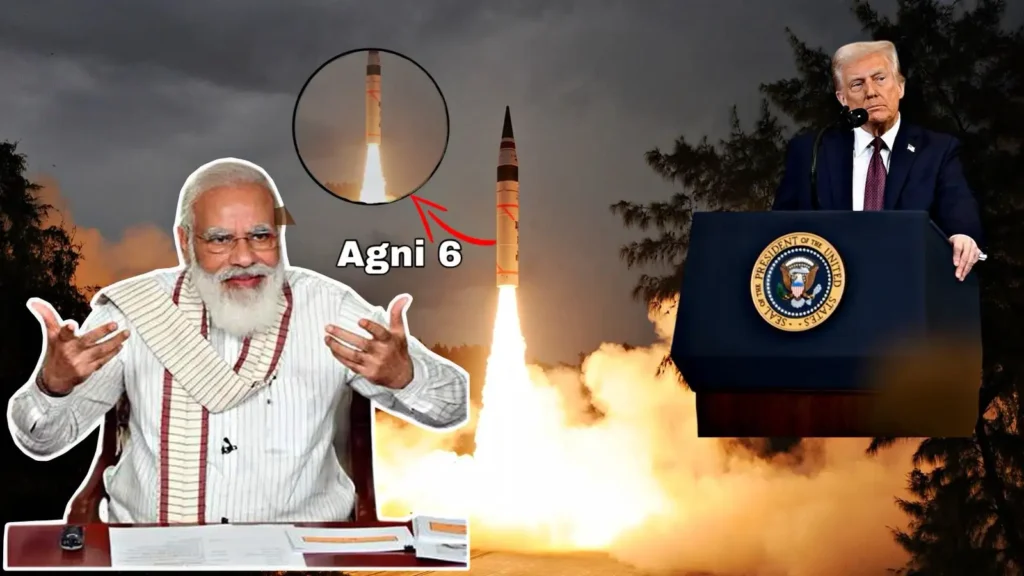
In the world of nuclear deterrence, breakthroughs are rarely loud—but their consequences echo for decades. India’s upcoming Agni-6 missile may be one such moment. While still awaiting final government approval, the system represents a leap that could quietly redraw the global strategic map.
Unlike previous advancements, this is not just about range—it’s about capability, survivability, and influence.
Background: India’s Evolving Missile Doctrine
India’s missile program has steadily evolved over the past few decades, moving from short-range tactical systems to long-range strategic deterrents. The Agni series, developed by the Defence Research and Development Organisation, has been central to this transformation.
Earlier systems like Agni-5 already gave India the ability to reach targets deep into Asia and parts of Europe. However, the Agni-6 missile is expected to push those limits even further—both in terms of range and sophistication.
According to reports from sources like the Daily hunt, DRDO leadership has confirmed that the program is technically ready and awaits political clearance
This signals a critical transition—from conceptual planning to imminent execution.
Current Developments: What We Know So Far
The Agni-6 missile is expected to feature:
- Intercontinental range (10,000–12,000 km or more)
- MIRV capability (Multiple Independently Targetable Reentry Vehicles)
- Enhanced survivability against modern missile defense systems
- Potential compatibility with land and sea-based platforms
These features collectively elevate the missile into the category of advanced intercontinental ballistic systems—technology possessed by only a handful of nations.
What makes this development particularly noteworthy is timing. With global tensions rising across multiple regions, the introduction of such a system is unlikely to be viewed in isolation.
Strategic Analysis: Why Agni-6 Matters
A Shift From Regional to Global Deterrence
Until recently, India’s nuclear doctrine was largely focused on regional deterrence, particularly concerning neighboring adversaries. The Agni-6 missile changes that equation. With its extended range, India effectively gains the ability to project deterrence on a global scale. This positions the country closer to established nuclear powers in terms of strategic reach.
The MIRV Factor
MIRV technology is a game changer. Instead of carrying a single warhead, a missile can deploy multiple warheads targeting different locations. This has two major implications:
- It increases strike efficiency
- It complicates interception for missile defense systems
In essence, it enhances both offensive capability and deterrence credibility.
Strategic Signaling
The development of the Agni-6 missile also sends a broader geopolitical signal. It reflects India’s intention to secure a long-term strategic position in a rapidly evolving global order. This is less about immediate conflict—and more about future-proofing national security.
Global Reactions: Concern, Caution, and Calculation
Pakistan: Immediate Concern
Pakistan has reacted with predictable concern, framing the development as a potential trigger for an arms race in South Asia. Given the fragile strategic balance in the region, such reactions are expected.
China: Strategic Watchfulness
China, already possessing advanced ICBM capabilities, is likely to monitor the development closely. While it may not publicly escalate rhetoric, the strategic implications will not go unnoticed.
Western Perspective
Western analysts tend to view India as a responsible nuclear power. However, the expansion into MIRV-equipped ICBMs raises questions about future strategic alignments and defense postures.
The response so far has been cautious rather than confrontational.
Possible Global Consequences
1. Acceleration of Regional Arms Dynamics
The introduction of advanced missile systems often leads to competitive responses. Countries in Asia may accelerate their own defense programs.
2. Pressure on Missile Defense Systems
As MIRV systems become more widespread, existing missile defense architectures could face new challenges, potentially triggering innovation cycles.
3. Recalibration of Strategic Alliances
India’s enhanced capabilities may influence its role in global alliances and partnerships, particularly in Indo-Pacific security frameworks.
4. Expansion of Deterrence Doctrine
The definition of deterrence itself may evolve—from regional stability to broader, multi-theater considerations.
Conclusion: A Defining Step in Strategic Evolution
The Agni-6 missile is not just another addition to India’s arsenal—it represents a strategic evolution. By combining long-range capability with advanced warhead technology, India is positioning itself among the top tier of global missile powers.
However, with greater capability comes greater responsibility. The true impact of Agni-6 will depend not just on its deployment, but on how it is integrated into India’s broader strategic doctrine.
In a world where deterrence is as much about perception as it is about power, Agni-6 could mark the beginning of a new era.
By Sahil Koul | Geopolitical Analyst