
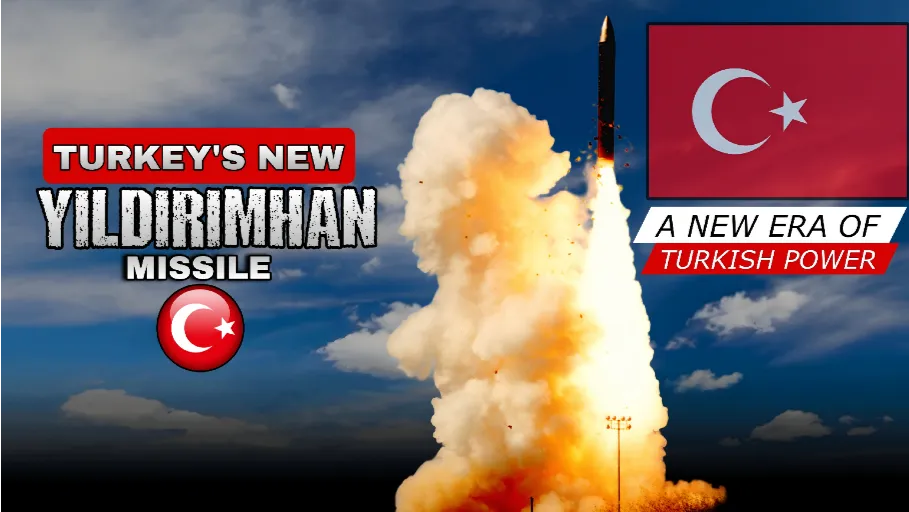
Turkey’s Long-Range Ambitions Enter the Spotlight
The Yildirimhan Missile has quickly become one of the most discussed developments in global defense circles. While many missile programs remain hidden from public view, Turkey has chosen to showcase its latest strategic project at a time of rising geopolitical competition. As a result, analysts are now asking whether this system marks a turning point in Ankara’s military ambitions.
Moreover, the unveiling arrives amid growing concerns over regional security and great-power rivalry. Therefore, the missile is being viewed not merely as a weapons platform but as a statement of national capability and strategic intent.
Why the Yildirimhan Missile Matters
Turkey has spent the past two decades investing heavily in domestic defense production. The country has steadily reduced its reliance on foreign suppliers while expanding its indigenous aerospace, drone, and missile industries. The emergence of the Yildirimhan Missile appears to be the latest step in that broader effort. According to publicly available information, the missile was unveiled during a major Turkish defense exhibition and was presented as a long-range strategic weapon with a reported range of approximately 6,000 kilometers.
According to the Arms Control Association, Turkey unveiled the YILDIRIMHAN as a long-range missile system that could significantly expand the country’s strategic strike capabilities.
If those specifications are ultimately validated, the missile would represent a dramatic leap beyond Turkey’s existing ballistic missile capabilities. Consequently, it would place Ankara in a category occupied by only a limited number of nations possessing strategic long-range missile technology.
Yildirimhan Missile Technology and Capabilities
The Yildirimhan Missile stands out because of the advanced technologies Turkey has reportedly integrated into its design. Rather than relying on solid fuel like many modern tactical missile systems, Turkish engineers appear to have equipped the missile with a liquid-fuel propulsion system. This technology enables longer-range operations, although crews typically need more time to prepare the missile for launch.
In addition, Turkish officials claim the missile can achieve hypersonic speeds, placing it among a growing class of advanced strategic weapons. While authorities have not released full operational details, military planners increasingly view hypersonic capability as a key element of modern deterrence strategies. As a result, several aspects of the missile’s design have drawn significant attention from defense analysts and policymakers worldwide.
Long-Range Strike Potential
The reported range of roughly 6,000 kilometers would significantly expand Turkey’s military reach. Such a distance could potentially place targets across large portions of Europe, Asia, Africa, and the Middle East within theoretical reach.
Mobile Launch Capability
Reports suggest the missile can be deployed from a road-mobile launcher. As a result, survivability could be improved because mobile systems are harder to locate and target.
Advanced Guidance Systems
Although detailed specifications remain classified, modern strategic missiles typically rely on sophisticated navigation and guidance technologies. Therefore, precision and reliability will likely be central elements of the program’s future development.
How the Yildirimhan Missile Could Change Turkey’s Global Position
The strategic significance of the Yildirimhan Missile extends beyond military technology. Historically, long-range missile programs have often been viewed as indicators of national technological maturity and strategic independence. Therefore, the development sends a message regarding Turkey’s growing confidence as a regional and international actor. For Ankara, the missile could provide several advantages.
First, it strengthens deterrence. Potential adversaries must consider the possibility of long-range retaliatory capabilities. Second, it enhances diplomatic leverage. Military capabilities frequently influence negotiations and security partnerships. Third, it reinforces Turkey’s goal of achieving greater defense autonomy. This objective has become increasingly important as international security dynamics continue to evolve. Consequently, the missile may become a symbol of Turkey’s broader geopolitical aspirations.
Which Countries Possess Similar Technologies?
Only a relatively small group of nations possess advanced long-range ballistic missile technologies. The United States, Russia, and China remain the most prominent examples. These countries operate sophisticated strategic missile forces and continue investing heavily in next-generation systems. Other countries with notable missile capabilities include France, the United Kingdom, India, and North Korea.
However, each nation has developed its missile programs under different strategic circumstances. Therefore, direct comparisons should be approached carefully. Nevertheless, Turkey’s reported ambitions indicate a desire to join an increasingly exclusive group of technologically advanced military powers.
Regional Reactions and Security Concerns
The appearance of the Yildirimhan Missile is likely to generate varied reactions across neighboring regions. Countries already involved in longstanding security disputes with Turkey may view the development cautiously. In particular, policymakers in Greece are expected to monitor the program closely. Likewise, governments throughout the Middle East will be assessing the implications for regional military balances. At the same time, NATO members may seek greater clarity regarding the strategic purpose of the missile. Turkey remains an important alliance member, and any significant expansion of military capability naturally attracts attention from partners and rivals alike. However, reactions are likely to depend on future testing, deployment decisions, and official policy statements.
Could the Reported Range Increase Further?
The Yildirimhan Missile reportedly offers a range of approximately 6,000 kilometers. However, many defense analysts expect future variants to deliver different performance levels. Engineers can extend or reduce a missile’s range by adjusting factors such as payload weight, propulsion efficiency, and overall design. As a result, future upgrades may significantly enhance the missile’s operational capabilities. Nevertheless, analysts cannot accurately assess the potential for extended ranges until Turkey releases additional technical data or conducts further testing. Until then, observers should evaluate the Yildirimhan Missile based on its officially announced specifications rather than on projections or assumptions.
Global Consequences of the Yildirimhan Missile
The broader consequences of the Yildirimhan Missile may extend well beyond Turkey’s borders. If the program advances successfully, it could encourage neighboring states to accelerate their own missile modernization efforts. As a result, regional competition in strategic technologies could intensify. Additionally, the missile may influence future discussions on arms control, missile defense, and regional security frameworks.
Meanwhile, defense industries around the world will likely study the program as an example of how emerging powers are expanding indigenous military production. Therefore, the long-term significance may ultimately be geopolitical rather than purely military.
Conclusion
The Yildirimhan Missile represents more than a new weapons system. It symbolizes Turkey’s growing ambition to become a major strategic power with advanced indigenous defense capabilities. Although many technical details remain unverified, the reported range, hypersonic characteristics, and strategic role have already generated international attention. Moreover, the program reflects broader shifts occurring throughout the global security landscape. Whether the Yildirimhan Missile ultimately transforms regional power dynamics will depend on future testing, deployment, and operational success. Nevertheless, its unveiling has already ensured that Turkey’s strategic ambitions are firmly in the international spotlight.
By Sahil Koul | Geopolitical Analyst