
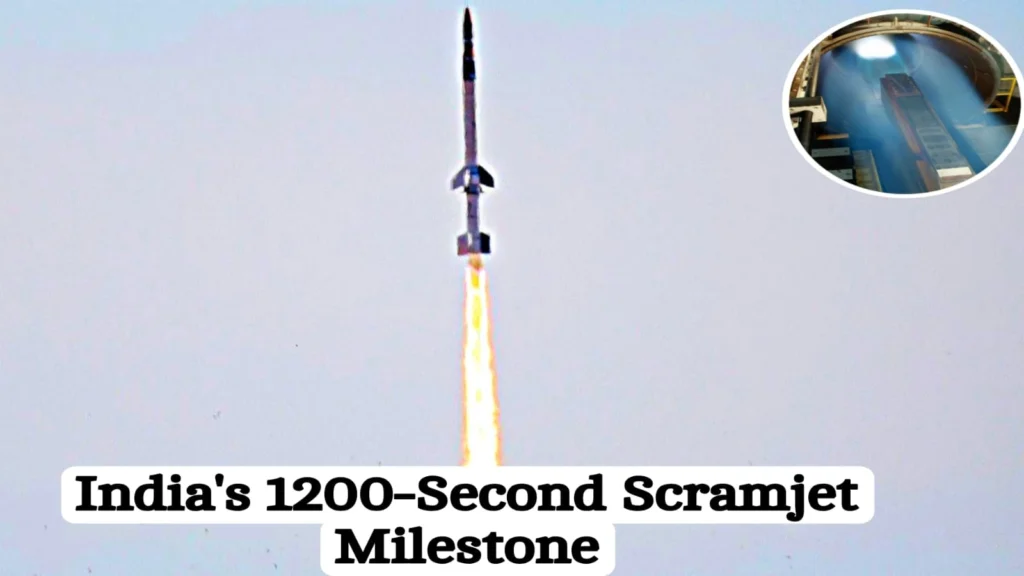
DRDO Scramjet Test Marks a New Chapter in India’s Hypersonic Journey
India’s pursuit of hypersonic technology has reached a significant milestone. The DRDO Scramjet Test achieved 1,200 seconds of sustained engine operation. This marks a major advance in the country’s next-generation aerospace ambitions. The achievement also highlights India’s growing ability to develop indigenous propulsion systems. These technologies could play an important role in future defence and aerospace applications.
The achievement is attracting attention well beyond India’s borders. Hypersonic technology is widely regarded as a critical military and strategic capability. Many global powers are racing to develop faster and more survivable systems. Against this backdrop, India’s latest success could influence regional security dynamics and broader international strategic calculations.
Background: Why Hypersonic Technology Matters
Hypersonic vehicles travel at speeds exceeding Mach 5, or five times the speed of sound. At such speeds, they can significantly reduce response times and complicate interception efforts. Unlike conventional rocket-powered systems, scramjet engines operate by compressing incoming air at supersonic speeds. This eliminates the need to carry oxidizers onboard, making the propulsion system potentially more efficient for sustained high-speed flight.
Official reports by Press information Bureau indicate that India is steadily advancing its hypersonic technology capabilities through sustained research and development efforts led by DRDO. The work reflects the country’s long-term focus on building cutting-edge aerospace and defence technologies through indigenous innovation. At the same time, the global competition for hypersonic systems is becoming increasingly intense, with leading military powers dedicating significant resources to advanced propulsion and high-speed weapon programs. As a result, breakthroughs in this field are now seen not only as scientific achievements but also as indicators of strategic influence and technological leadership in an evolving security landscape.
What Happened During the DRDO Scramjet Test?
The latest test focused on validating the performance of a hypersonic scramjet engine over an extended duration. Sustained operation is one of the most challenging aspects of hypersonic propulsion. While short-duration demonstrations can prove basic functionality, long-duration testing provides evidence that critical systems can withstand extreme temperatures, pressures, and aerodynamic stresses.
The reported 1,200-second operation represents a substantial endurance milestone. Furthermore, it offers valuable data on combustion stability, thermal management, and propulsion efficiency. Such testing is crucial because hypersonic systems must operate reliably under conditions that exceed those faced by most conventional aircraft and missiles. Therefore, endurance achievements often carry as much significance as speed records.
Why the DRDO Scramjet Test Is Strategically Important
The strategic significance of the DRDO Scramjet Test extends well beyond a technological achievement. As hypersonic capabilities increasingly shape the future of military power, the successful 1,200-second engine operation highlights India’s growing ability to develop complex indigenous defence technologies. The milestone supports New Delhi’s broader objective of strengthening self-reliance in critical defence sectors while reducing long-term dependence on foreign military systems.
The breakthrough also lays the foundation for a range of future applications, including hypersonic cruise missiles, advanced reconnaissance platforms, and rapid-response aerospace vehicles. Beyond its military potential, the achievement enhances India’s reputation as an emerging leader in advanced aerospace research. At a time of intensifying strategic competition across the Indo-Pacific, progress in hypersonic propulsion strengthens India’s technological credibility, boosts its appeal as a defence partner, and reinforces its position among the world’s leading innovation-driven powers.
Geopolitical Implications of India’s Hypersonic Progress
The geopolitical impact of the DRDO Scramjet Test could be significant. Across Asia, military modernization efforts continue to accelerate as nations invest heavily in advanced missiles, surveillance networks, cyber capabilities, and space-based assets. Hypersonic technologies have become a central element of this competition, with major powers viewing them as critical to future defence strategies. For India, the successful test strengthens its technological foundation for next-generation defence systems and contributes to its broader strategic deterrence capabilities, even though the test itself is not linked to an operational weapon platform.
The achievement is also likely to attract close attention from neighbouring countries, as advances in military technology often influence regional security calculations and defence planning. Beyond South Asia, the breakthrough reinforces India’s reputation as an emerging technology and innovation power. As countries increasingly evaluate defence partners based on research expertise and advanced industrial capabilities, progress in hypersonic propulsion could enhance India’s role in future strategic partnerships while expanding its influence within the evolving Indo-Pacific security landscape.
Potential Global Consequences
The global race for hypersonic capabilities is already reshaping defence planning. As more countries develop advanced propulsion systems, traditional missile defence networks may face new challenges. Hypersonic vehicles can travel at extreme speeds and manoeuvre during flight. This makes detection, tracking, and interception far more difficult. India’s progress adds another important player to this evolving landscape. The successful indigenous test also shows that advanced hypersonic research is no longer limited to a small group of nations.
This growing competition could encourage further investments in aerospace research and next-generation defence technologies worldwide. At the same time, it may increase calls for international dialogue on the implications of emerging military capabilities. Some analysts argue that hypersonic systems could alter strategic stability by changing the balance between offense and defence, while others believe they will primarily strengthen deterrence. Regardless of the debate, hypersonic technology is becoming an increasingly important factor in future security and defence planning.
What Comes Next?
Although the achievement is significant, further development is required before operational deployment becomes possible. Future milestones may include flight demonstrations, system-level testing, and validation of complete hypersonic platforms. Engineers must also overcome challenges involving advanced materials, guidance systems, and long-term reliability. Nevertheless, the successful DRDO Scramjet Test provides a strong foundation for future progress. More importantly, it confirms that India’s hypersonic research program continues to move forward steadily.
Conclusion
The DRDO Scramjet Test represents more than a technical achievement. It highlights India’s growing capability in one of the world’s most advanced technology sectors. The successful 1,200-second engine operation marks important progress in hypersonic propulsion, a field that is increasingly influencing military and geopolitical strategy. Although operational systems may still be years away, the breakthrough strengthens India’s position in the global hypersonic race. As competition among major powers grows, such achievements will have wider strategic implications. The test also reflects a broader shift toward advanced technologies that could shape international security for decades.
By Simran Verma | Geopolitical Analyst