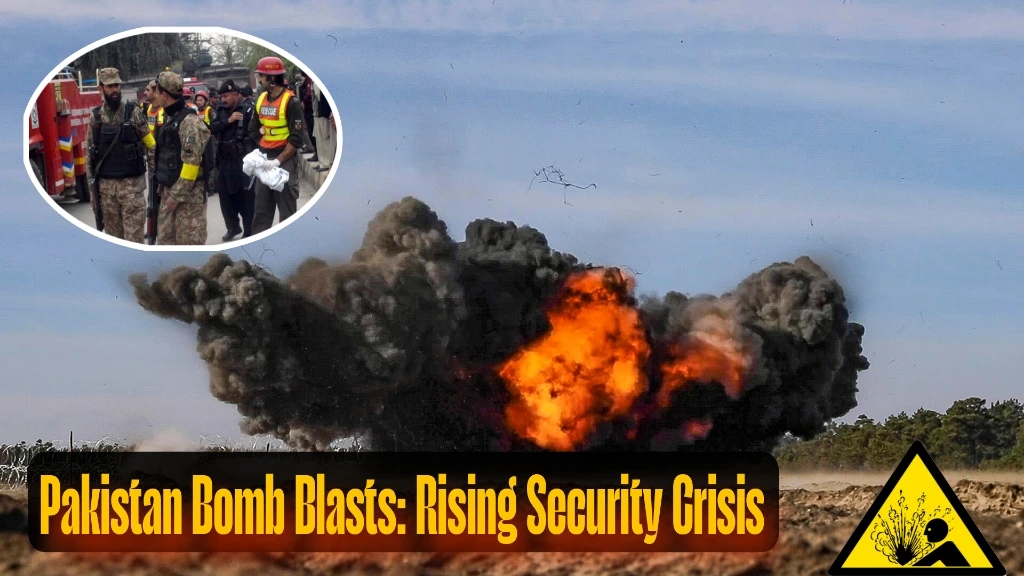
Pakistan Bomb blasts are once again dominating regional security discussions. Deadly attacks have returned to major headlines after years of relative decline. Moreover, the growing frequency of explosions has revived fears of another prolonged militant crisis. Over the past decade, Pakistan has faced repeated waves of violence. However, recent attacks suggest a dangerous shift. Militancy is no longer limited to remote border regions. Instead, violence is spreading across urban centres, highways, and strategic provinces.
According to the South Asia Terrorism Portal, Militant attacks in Pakistan have sharply increased in recent years, especially in Balochistan and Khyber Pakhtunkhwa. Security forces, police convoys, political gatherings, and religious events have become frequent targets. In several cases, suicide bombings and roadside explosions caused heavy civilian casualties. Moreover, armed groups have expanded their operations beyond remote border districts. This shift has raised concerns about a weakening of security controls in sensitive regions. Analysts also warn that militant organisations are becoming more coordinated and technologically advanced. Consequently, Pakistan’s internal security environment has become increasingly fragile.
Pakistan Bomb Blasts Return After Years of Decline
Pakistan spent years attempting to reduce extremist violence through military operations. Campaigns such as Zarb-e-Azb and Radd-ul-Fasaad weakened several militant networks. As a result, terror incidents declined after 2015. However, the security environment has changed dramatically since the Taliban returned to power in Afghanistan in 2021. Since then, Pakistan bomb blasts have increased steadily. Security officials now warn that militant groups are reorganising faster than expected.
Many attacks target police convoys, military installations, and political gatherings. Suicide bombings have also returned to several regions. This pattern resembles the violent period Pakistan experienced during the late 2000s. Furthermore, separatist violence in Balochistan continues to intensify. Armed groups frequently target infrastructure projects and security personnel. Therefore, the state now faces threats from both Islamist militants and ethnic insurgent networks.
Why Pakistan Bomb Blasts Are Rising Again
Several factors explain the resurgence of violence in Pakistan. First, instability in neighbouring Afghanistan has created new security complications, while militants reportedly move across porous border areas with greater freedom. Second, Pakistan’s economic crisis has weakened governance structures. Inflation, unemployment, and political instability have increased public frustration. Consequently, extremist organisations often exploit these conditions to recruit supporters.
In addition, political polarisation has diverted attention from long-term counterterrorism planning, as rival political parties continue to fight for influence while security threats grow in the background. Another major factor involves the Tehreek-e-Taliban Pakistan (TTP), which has regained strength over recent years. Pakistani authorities accuse Afghanistan’s Taliban government of failing to restrain TTP activities near the border. Although Kabul denies these allegations, tensions between the two countries continue rising. Border clashes and diplomatic disputes now occur more frequently. Therefore, regional mistrust is deepening at a critical moment.
Balochistan and Khyber Pakhtunkhwa Remain Key Targets
The provinces of Balochistan and Khyber Pakhtunkhwa remain the most affected regions. Both areas face unique security pressures. However, they share weak infrastructure, difficult terrain, and longstanding political grievances.
In Balochistan, separatist organisations oppose federal control and foreign investment projects. Chinese-backed infrastructure initiatives have become major targets. Militants argue that local populations receive limited economic benefits from these developments. As a result, attacks against Chinese interests have increased international concern. Beijing has repeatedly urged Pakistan to strengthen security protections for its nationals and projects.
Meanwhile, Khyber Pakhtunkhwa continues facing cross-border militant infiltration. Police stations, checkpoints, and tribal districts frequently come under attack. Residents in several districts now fear a return to constant instability. Moreover, local communities often face economic disruption after attacks. Businesses close earlier, tourism declines, and investment confidence weakens. Therefore, the social impact extends far beyond immediate casualties.
Geopolitical Implications for South Asia
The rise in Pakistan bomb blasts carries serious geopolitical consequences. Pakistan occupies a central position in South Asian security dynamics. Therefore, instability inside the country affects multiple regional actors, including neighbouring states and global powers.
China remains deeply invested in Pakistan through the China-Pakistan Economic Corridor (CPEC). Continued violence threatens infrastructure security and investment confidence. Consequently, Beijing may demand stronger counterterrorism measures from Islamabad, along with stricter security guarantees for ongoing and future projects.
At the same time, tensions between Pakistan and Afghanistan could worsen further, particularly along contested border regions and security corridors. Both countries accuse each other of supporting hostile groups and providing safe havens. This mutual distrust complicates border security cooperation, intelligence sharing, and coordinated counterterrorism efforts across the region.
India is also monitoring developments closely. Rising instability in Pakistan could reshape regional security calculations and influence defence planning across South Asia. Furthermore, any major terror incident risks increasing diplomatic tensions between the two nuclear-armed neighbours. Such developments could lead to heightened military alertness, reduced diplomatic engagement, and greater uncertainty along the border, potentially affecting regional stability and security cooperation.
The United States and Western allies remain concerned about extremist regrouping across the Afghanistan-Pakistan region. Many analysts fear that ungoverned spaces could again become safe havens for transnational militant organisations, potentially enabling cross-border planning, recruitment, and attacks that may extend beyond South Asia. Therefore, Pakistan’s security challenges now carry international significance beyond domestic politics
Could Pakistan Bomb Blasts Trigger Another Security Crisis?
Pakistan’s leadership insists that security forces remain capable of controlling militant threats. Military operations continue across several sensitive districts. Intelligence agencies also claim to have prevented numerous planned attacks. Nevertheless, experts warn that military action alone may not solve the problem. Long-term stability requires economic reforms, political consensus, and improved governance.
Public confidence also plays an important role. Citizens increasingly question whether authorities can prevent future attacks. Each new bombing intensifies concerns about national stability. Furthermore, social media has amplified public anxiety. Graphic footage and breaking updates spread rapidly after every incident. Consequently, fear often reaches far beyond the attack location itself.
If violence continues rising, Pakistan could face serious economic consequences. Foreign investment may decline further, as investor confidence weakens amid persistent security risks. Tourism and trade could also suffer long-term damage, with disrupted supply chains, higher insurance costs, and reduced regional economic integration compounding the overall economic slowdown.
Global Consequences of Pakistan’s Security Instability
The international community cannot ignore Pakistan’s security trajectory. Pakistan possesses nuclear capabilities and occupies a strategic geopolitical location at the crossroads of South Asia, Central Asia, and the Middle East. Therefore, prolonged instability creates broader global concerns, particularly regarding regional balance, counterterrorism coordination, and the safety of critical infrastructure corridors.
Global markets closely watch security conditions surrounding major trade routes and infrastructure projects. Any sustained escalation could affect regional connectivity plans across Asia. Additionally, extremist networks often operate across borders. Increased militancy inside Pakistan could encourage wider regional radicalisation. This possibility worries governments across the Middle East, Central Asia, and South Asia. Humanitarian concerns also remain important. Rising violence may increase internal displacement in affected provinces. Vulnerable communities often suffer the most during prolonged instability.
Conclusion
Pakistan bomb blasts are no longer isolated security incidents. Instead, they represent a deeper warning about regional instability, political divisions, and evolving militant strategies that are adapting to shifting geopolitical conditions and security gaps across the region.
Although Pakistan successfully reduced violence during the previous decade, the current resurgence presents new challenges. Militancy has adapted to changing geopolitical realities. Therefore, authorities now face a more complex security environment that demands coordinated intelligence sharing, stronger border management, and long-term counter-radicalisation strategies across affected provinces.
The coming years may determine whether Pakistan can prevent another prolonged era of violence. Success will depend not only on military action but also on political unity, economic recovery, institutional reform, and sustained regional cooperation with neighbouring countries to address shared security threats.
By Simran Verma | Geopolitical Analyst