
Climate Fears Are Being Intensified Worldwide
Global climate institutions are raising concerns about Super El Niño 2026 as several forecasting models project severe weather disruptions. Governments worldwide are reviewing emergency planning measures to prepare for possible climate impacts. At the same time, rising climate instability is exposing major economic vulnerabilities. Pressure is also increasing on food markets, energy systems, and global supply chains. Consequently, fears of another large-scale global climate shock continue to grow.
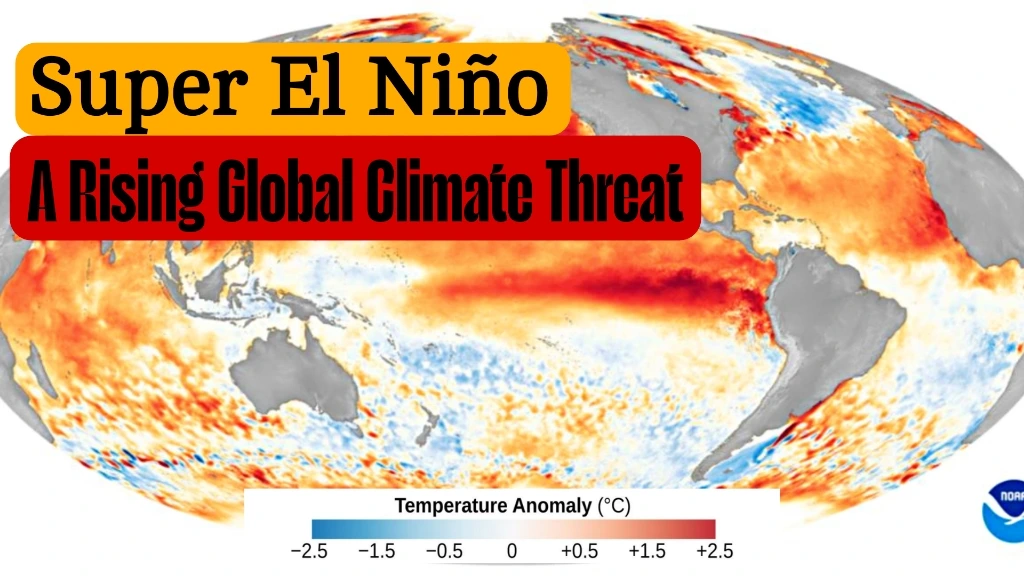
According to a report by Down To Earth, the world could be approaching one of the strongest El Niño events ever recorded, driven by unusually rapid warming across the Pacific Ocean. Researchers also warn that the interaction between El Niño and rising global temperatures could intensify the impact of already unstable weather systems. Many regions may experience harsher summers, declining agricultural output, shrinking freshwater reserves and increased pressure on disaster-response infrastructure. Climate analysts fear that vulnerable populations, particularly in developing nations, could face the greatest consequences if the phenomenon continues to strengthen over the coming months.
What Is Super El Niño 2026?
Scientists describe El Niño as a natural warming of ocean waters in the Pacific Ocean. However, experts consider a Super El Niño far more dangerous because it can heavily disrupt global weather systems. During El Niño periods, trade winds usually weaken, allowing warm ocean waters to move eastward across the Pacific. As a result, rainfall patterns and atmospheric circulation change significantly around the world. Historically, major Super El Niño events occurred in 1982–83, 1997–98, and 2015–16. Those years brought devastating floods, droughts, crop failures, and extreme weather conditions across multiple regions.
Several impacts are usually associated with powerful El Niño events:
- Severe climate conditions can trigger crop failures across vulnerable agricultural regions.
- Water shortages are intensified in drought-prone countries
- Flooding risks increase significantly in many coastal and tropical regions during severe climate events.
- Severe climate disruptions can heavily damage marine ecosystems and ocean biodiversity
- Food and energy markets experience growing inflationary pressure during major climate disruptions.
Scientists and policymakers no longer view Super El Niño 2026 only as a climate event.. Governments and analysts increasingly see it as a growing geopolitical risk with potential economic, food security, and global stability consequences.
Why the World Is Watching Super El Niño 2026
Ocean temperatures have recently reached record highs. Consequently, climate experts now monitor conditions more aggressively. Although scientists have not reached certainty, they observe several warning signs. Additionally, global warming trends have already amplified climate volatility. As a result, experts anticipate stronger weather extremes in the coming years.
Scientists and climate agencies are monitoring rising sea temperatures.
Sea surface temperatures have remained consistently elevated across several major ocean regions in recent years. As a result, stronger atmospheric disturbances could emerge in the coming decades. Warmer oceans also provide additional energy for storms, cyclones, and heatwaves, increasing their intensity. Consequently, global weather systems are becoming more unstable, unpredictable, and increasingly difficult for scientists and governments to accurately forecast.
Governments and experts are raising concerns about food supply.
Scientists expect agricultural output to decline across large parts of Asia, Africa, and Latin America due to droughts, floods, and unstable weather conditions linked to Super El Niño 2026. Analysts anticipate disruptions in key global markets, including rice, wheat, cocoa, coffee, and sugar. As a result, experts expect food prices to rise sharply worldwide, and policymakers and economic analysts actively discuss increasing inflation risks.
Energy markets could face increasing pressure.
Hydropower production may decline significantly during prolonged drought conditions caused by severe climate disruptions. At the same time, electricity demand could rise sharply during extreme heatwaves as cooling needs increase. Consequently, vulnerable regions may experience energy shortages, higher power costs, grid instability, and increased pressure on already strained energy infrastructure systems.
How Super El Niño 2026 Could Reshape Geopolitics
Climate events no longer act as isolated environmental challenges that affect only weather patterns. Governments, researchers, and global institutions increasingly link extreme climate disruptions with geopolitical instability, economic uncertainty, migration pressures, food insecurity, energy disruptions, and rising tensions between vulnerable nations worldwide.
Asia Could Face Agricultural Disruptions
South and Southeast Asia depend heavily on seasonal monsoons. However, El Niño conditions can weaken rainfall patterns across the region. As a result, disrupted food production may affect India, Thailand, Vietnam, and Indonesia. Rural economies can also suffer damage from reduced agricultural output. Furthermore, governments may impose export restrictions on rice and other key commodities. Consequently, global food prices can rise sharply.
African Nations Could Face Severe Droughts
El Niño cycles often affect Eastern and Southern Africa, intensifying water shortages and crop failures. These conditions can overwhelm humanitarian aid systems. In addition, they may increase migration pressures across fragile regions. Local communities may face rising food insecurity, livestock losses, and reduced access to clean water. Economic activity can slow further as agriculture-dependent livelihoods come under severe stress, deepening existing vulnerabilities across already fragile areas.
Latin America Could Experience Flood Damage
El Niño periods have historically brought heavy rainfall to parts of South America. Therefore, severe flooding can damage infrastructure systems across the region. Transport routes, ports, and urban centres can also face disruption. Consequently, reconstruction costs may rise sharply, while governments and local authorities may struggle to restore services and maintain economic stability.
Strategic Competition Could Be Intensified
Competition for food, water, and energy resources can become more aggressive during major climate disruptions. Nations with stronger reserves can gain strategic leverage in global negotiations and resource distribution. Meanwhile, vulnerable economies may depend more heavily on international assistance to meet basic needs. As a result, climate resilience can increasingly shape geopolitical influence and power dynamics worldwide.
Global Economic Consequences Could Be Severe
The economic effects of Super El Niño 2026 would likely extend far beyond climate-sensitive regions, influencing global agriculture, shipping routes, commodity prices, energy demand, insurance costs, and financial markets. Economists warn that prolonged climate disruptions can intensify inflation, strain vulnerable economies, disrupt supply chains, and increase pressure on governments that already face economic uncertainty.
Rising food prices could accelerate inflation.
Major El Niño years often disrupt agricultural production and global supply chains, which strongly affect commodity prices worldwide. As a result, consumers face higher prices for essential food products, while markets for coffee, sugar, rice, vegetable oils, and other climate-sensitive commodities experience severe volatility and prolonged instability across global trade systems.
Climate disruptions could interrupt supply chains
Floods, storms, and extreme weather linked to Super El Niño 2026 could damage major shipping routes, ports, and manufacturing hubs. As a result, delivery delays, trade disruptions, rising transport costs, and supply chain instability may increase, affecting global industries that depend heavily on predictable logistics and uninterrupted international commercial networks.
Insurance Costs Could Rise
Climate-related disasters are already causing major insurance losses across global markets. Another severe climate event could push insurance premiums even higher for businesses, farmers, and households. Financial institutions may also face rising climate exposure risks through damaged assets, disrupted investments, increased loan defaults, and growing uncertainty across vulnerable economic sectors worldwide.
Is the World Preparing Better Than Before?
Governments and international agencies are working to improve climate preparedness as concerns over future El Niño risks continue to grow. Several countries are expanding flood defences, strengthening emergency food reserves, and upgrading climate forecasting systems to provide earlier warnings. Authorities are also investing in water management systems, disaster relief planning, climate-resilient agriculture, and emergency healthcare infrastructure.
However, preparedness levels remain highly uneven across the world. Developed economies generally possess stronger disaster response systems, better financial reserves, and more advanced infrastructure, allowing them to recover more quickly from climate-related disasters. Meanwhile, poorer nations often remain far more exposed due to weak infrastructure, limited funding, and greater dependence on climate-sensitive sectors such as agriculture and fisheries.
Many vulnerable countries may struggle to respond effectively to prolonged droughts, floods, food shortages, and energy disruptions during a severe El Niño cycle. Consequently, another major El Niño event could deepen existing global inequalities, intensify humanitarian crises, increase migration pressures, and place additional strain on international aid systems and global economic stability
Conclusion
Scientists, governments, and international agencies increasingly treat Super El Niño 2026 as a growing global threat rather than only a climate phenomenon. Although significant uncertainty still exists regarding its timing and intensity, experts closely monitor warning signals across global ocean and atmospheric systems. At the same time, ongoing economic instability, geopolitical tensions, fragile supply chains, and rising global food insecurity intensify climate vulnerability. Therefore, the next major El Niño event could bring consequences that extend far beyond weather-related disruptions alone.
Food security, migration patterns, international trade, water availability, and global energy systems can all come under simultaneous pressure during a severe climate cycle. As a result, countries are increasing international coordination, strengthening disaster preparedness, and improving climate resilience strategies to help maintain global stability.
Ultimately, people around the world are now asking one critical question: Is the world truly prepared for Super El Niño 2026?
By Simran Verma | Geopolitical Analyst