A Diplomatic Dispute Expands Beyond Taiwan
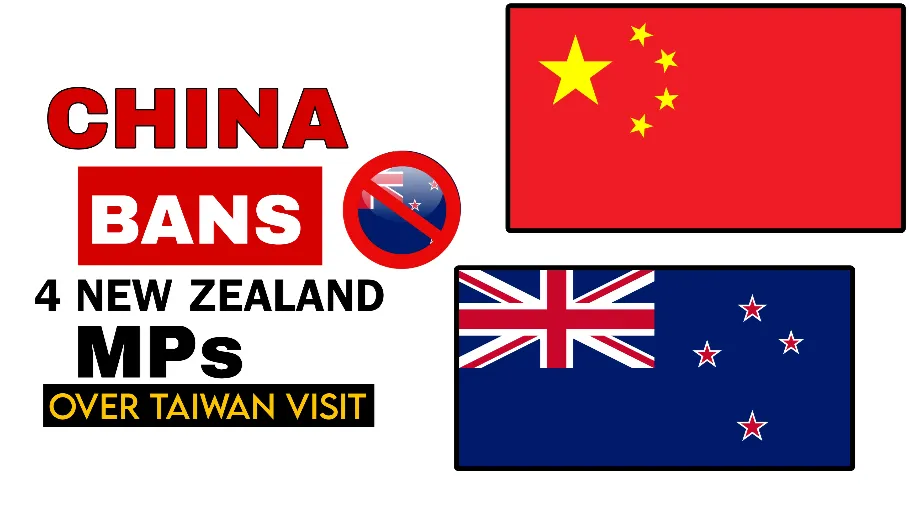
The decision has sparked debate far beyond New Zealand’s borders. China bans New Zealand MPs after their visit to Taiwan, a move that has drawn attention across the Indo-Pacific region and renewed concerns about growing tensions surrounding the island. The latest controversy emerged after China imposed travel restrictions on four New Zealand members of parliament following their visit to Taiwan. The development quickly became a diplomatic issue between Wellington and Beijing. More importantly, it raised questions about how countries can balance relations with China while maintaining unofficial engagement with Taiwan. The incident highlights the increasingly sensitive nature of cross-strait politics. It also demonstrates how Taiwan remains one of the most important flashpoints in international diplomacy today.
Why China Bans New Zealand MPs
The current dispute began after a cross-party delegation of New Zealand lawmakers traveled to Taiwan in May 2026. During the visit, the MPs met Taiwanese officials and discussed political, economic, and regional issues. China strongly objected to the trip. Beijing considers Taiwan part of its territory under the One-China Principle. As a result, Chinese authorities viewed the parliamentary visit as an action that challenged China’s sovereignty claims.
According to reports and official statements, China subsequently imposed a one-year travel ban on four participating lawmakers. The restrictions reportedly apply to mainland China, Hong Kong, and Macau.
Official remarks concerning the restrictions on the four New Zealand lawmakers and China’s Taiwan policy were published by the Chinese Embassy in New Zealand.
The decision immediately attracted international attention because parliamentary visits to Taiwan have become increasingly common among lawmakers from democratic countries.
Current Developments in the Dispute
The announcement surprised many observers in New Zealand. Government officials argued that parliamentary visits to Taiwan are not inconsistent with Wellington’s long-standing One-China policy. New Zealand maintains formal diplomatic relations with Beijing. However, it also preserves unofficial economic and cultural ties with Taiwan. This approach mirrors the policies adopted by many Western democracies.
Following the restrictions, several New Zealand political figures criticized the move. They argued that elected representatives should be free to engage with international partners without facing foreign sanctions. Meanwhile, Chinese officials defended the action. Beijing stated that foreign politicians who challenge China’s position on Taiwan should expect consequences. As the diplomatic disagreement continued, analysts began examining the broader message behind the decision. Many concluded that the action was intended to discourage similar visits by lawmakers from other countries.
How China Bans New Zealand MPs Reflect a Broader Taiwan Strategy
The travel restrictions did not occur in isolation. Instead, they fit into a larger pattern of Chinese efforts to reinforce its position on Taiwan. Over recent years, Beijing has increased diplomatic, military, and economic pressure related to Taiwan. Chinese leaders argue that foreign governments should avoid any actions that could be interpreted as support for Taiwanese independence. Consequently, visits by foreign parliamentarians have become increasingly sensitive. China views these exchanges as political signals rather than routine diplomatic engagement.
From Beijing’s perspective, responding firmly serves multiple purposes. First, it reinforces China’s sovereignty claims. Second, it discourages future parliamentary delegations from making similar trips. Third, it demonstrates consistency in China’s Taiwan policy. Therefore, when China bans New Zealand MPs, the action sends a message not only to Wellington but also to other governments considering similar engagements.
Geopolitical Implications for New Zealand
New Zealand now faces a delicate diplomatic challenge. For decades, Wellington has pursued a balanced foreign policy. China remains one of New Zealand’s largest trading partners. At the same time, New Zealand maintains close relationships with democratic allies across the Indo-Pacific. The latest dispute illustrates the difficulty of maintaining both objectives simultaneously. If tensions continue, New Zealand may encounter increasing pressure to clarify its approach toward Taiwan. However, policymakers are likely to avoid dramatic policy changes.
Instead, Wellington may seek to preserve economic cooperation with China while defending the independence of its parliament. The situation also highlights a broader issue affecting middle powers. Countries often find themselves navigating competition between major global actors while protecting their own political autonomy.
What the International Community Is Saying
Reactions from abroad have been closely watched. Several analysts described the move as another example of China’s growing willingness to use diplomatic tools in pursuit of strategic goals. Supporters of stronger engagement with Taiwan expressed concern about the restrictions. They argued that lawmakers should be able to conduct international visits without fear of retaliation.
Others emphasized the importance of respecting existing diplomatic frameworks. They noted that governments must carefully manage relations involving Taiwan because of the issue’s sensitivity. Although no major international crisis has emerged, the incident has intensified discussions about parliamentary diplomacy and national sovereignty. As a result, many governments will likely study the situation closely.
Possible Global Consequences
The decision may have consequences extending beyond New Zealand. First, some foreign lawmakers could become more cautious about visiting Taiwan. Second, other parliamentary groups may proceed with visits specifically to demonstrate support for democratic engagement. Third, tensions surrounding Taiwan could become a more prominent factor in bilateral relations worldwide. The incident may also influence future discussions about economic security and diplomatic resilience.
Countries increasingly recognize that political disputes can affect broader international relationships. Therefore, governments are investing greater attention in managing geopolitical risk. Furthermore, the case could contribute to growing debates regarding the limits of diplomatic pressure in international affairs. If similar measures become more common, governments may seek new approaches to protect political exchanges while maintaining stable relations with major powers.
Why China Bans New Zealand MPs Matters Beyond One Dispute
The significance of this case extends beyond four lawmakers. When China bans New Zealand MPs, it demonstrates how Taiwan continues to shape international diplomacy. It also highlights the challenges facing countries that seek engagement with both Beijing and Taipei. The episode underscores a wider geopolitical reality. Strategic competition in the Indo-Pacific increasingly influences decisions that once appeared routine.
As a result, parliamentary visits, diplomatic meetings, and symbolic gestures now carry greater political weight than before. The dispute may eventually fade. However, the underlying tensions are likely to remain.
Conclusion
The decision that saw China bans New Zealand MPs represents more than a bilateral disagreement. It reflects Beijing’s determination to defend its Taiwan policy and discourage actions it views as challenging its sovereignty claims. At the same time, the controversy highlights the balancing act confronting countries such as New Zealand. Governments want productive relations with China, yet they also seek to maintain independent political engagement.
As competition surrounding Taiwan continues to shape global politics, similar disputes may become increasingly common. Consequently, policymakers around the world will watch closely to see how both Beijing and Wellington manage the fallout from this latest diplomatic confrontation.
By Sahil Koul | Geopolitical Analyst