Modi G7 Summit Signals India’s Rising Global Influence
The Modi G7 Summit visit attracted worldwide attention at a time of growing geopolitical uncertainty. From trade tensions to regional conflicts, global leaders arrived at the summit seeking solutions to increasingly complex challenges. Against this backdrop, Prime Minister Narendra Modi’s participation highlighted India’s expanding role in international affairs.
More importantly, the visit was not merely symbolic. It provided New Delhi with an opportunity to strengthen partnerships, advance strategic interests, and position itself as a bridge between developed economies and emerging nations. As a result, the summit became another milestone in India’s diplomatic journey.
Why the G7 Summit Matters
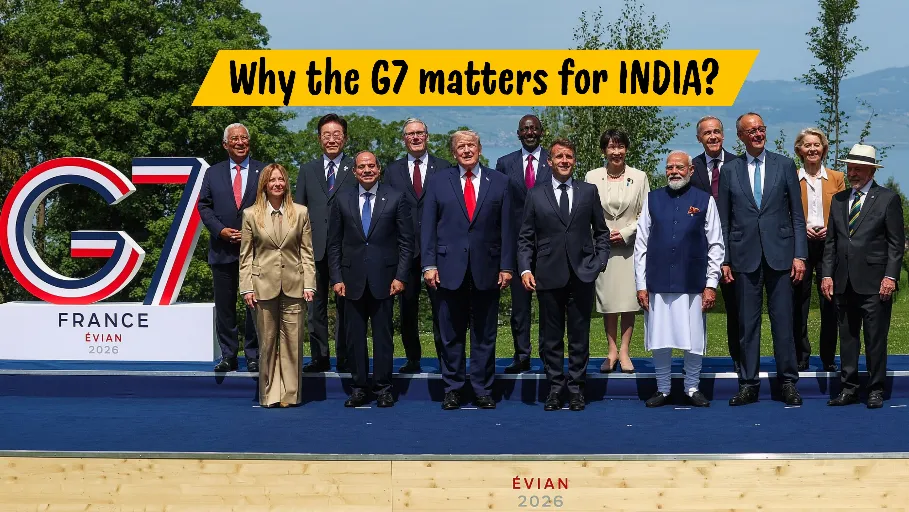
The Group of Seven (G7) consists of Canada, the United States, the United Kingdom, France, Germany, Italy, and Japan, along with participation from the European Union. Although India is not a permanent member, it has increasingly been invited as a key partner due to its economic growth and geopolitical significance. The 2026 summit focused on global economic resilience, supply chain security, artificial intelligence, energy transition, and international security challenges. These issues have become more urgent as countries face economic uncertainty and escalating geopolitical competition.
For official updates on Prime Minister Narendra Modi’s participation in the G7 Summit and related diplomatic engagements, readers can visit News On Air’s coverage of the visit.
India’s presence reflected the growing recognition that major global challenges cannot be addressed without meaningful engagement from the world’s most populous nation and one of its fastest-growing economies.
What Was the Main Purpose of Modi’s Visit?
Prime Minister Modi attended the summit with several objectives. First, he sought to strengthen India’s relationships with leading industrial economies. Second, he aimed to expand cooperation in critical technologies, trade, investment, and security. At the same time, India continued advocating for the interests of developing nations. New Delhi has consistently argued that global governance institutions should better reflect current economic realities. Therefore, Modi’s participation also served as a platform to amplify the concerns of the Global South. Another important objective involved attracting greater investment into India’s manufacturing, technology, and infrastructure sectors. As multinational companies diversify supply chains, India hopes to position itself as a reliable economic partner.
Modi Meets Trump: A High-Profile Bilateral Engagement
One of the most closely watched moments of the summit was the meeting between Prime Minister Modi and U.S. President Donald Trump. The discussions reportedly focused on strengthening economic cooperation, expanding trade opportunities, and enhancing strategic coordination. Both leaders also examined developments in the Indo-Pacific region, which remains central to the foreign policy priorities of both nations.
In addition, technology partnerships featured prominently in discussions. Artificial intelligence, semiconductor production, and advanced manufacturing have emerged as areas where India and the United States see significant opportunities for collaboration. The meeting underscored the importance of the India-U.S. relationship. Despite differences on certain trade issues, both countries continue to view each other as important strategic partners.
Key Outcomes of the Modi G7 Summit
Trade and Investment Cooperation
Economic cooperation remained a major theme throughout the summit. India promoted itself as a stable destination for global investment. Meanwhile, discussions focused on improving supply chain resilience and reducing vulnerabilities in critical sectors. Many countries are seeking alternatives to concentrated manufacturing networks. Consequently, India is increasingly viewed as an attractive partner for diversification efforts.
Technology Partnerships
Emerging technologies received considerable attention. Artificial intelligence, cybersecurity, quantum computing, and semiconductor development were among the priority areas discussed. India’s rapidly expanding digital economy gives it a strong position in these conversations. Therefore, deeper technological cooperation could generate long-term strategic benefits.
Security and Strategic Cooperation
Security concerns also shaped many summit discussions. Ongoing conflicts, maritime security challenges, and regional instability remain major concerns for global leaders. India emphasized the importance of maintaining a free, open, and inclusive Indo-Pacific region. This position aligns with the strategic priorities of several G7 countries.
Energy and Climate Initiatives
The summit also explored pathways toward energy security and sustainable development. India highlighted its renewable energy ambitions while emphasizing the need for realistic and equitable climate policies. Developing economies often face unique challenges during energy transitions. Therefore, India argued for balanced approaches that support growth while advancing environmental goals.
Geopolitical Implications of the Modi G7 Summit
The geopolitical significance of Modi’s participation extends beyond individual agreements. First, India’s presence reinforced its status as a major global actor. Unlike previous decades, New Delhi now plays a central role in discussions involving economics, technology, and security. Second, the summit demonstrated India’s strategy of maintaining partnerships with multiple power centers. Rather than aligning exclusively with one bloc, India continues pursuing strategic autonomy.
This approach allows New Delhi to cooperate with Western nations while preserving relationships across different regions. As global competition intensifies, this flexibility may become increasingly valuable. Third, India’s growing influence could contribute to a more multipolar international system. Many countries view India as an important balancing force in global affairs.
How the World Reacted
International reactions largely reflected recognition of India’s rising profile. Western governments welcomed India’s participation in discussions involving economic resilience and technological cooperation. Business leaders also expressed interest in India’s expanding market opportunities. Meanwhile, developing countries closely watched India’s engagement with leading economies. Many see India as a voice capable of representing broader concerns from the Global South. Analysts noted that Modi’s active diplomacy demonstrated India’s ambition to shape international conversations rather than simply respond to them.
Possible Global Consequences
Several long-term consequences could emerge from the summit. First, stronger India-G7 cooperation may accelerate investment flows into critical sectors. This could support global supply chain diversification efforts. Second, increased collaboration in technology could reshape innovation ecosystems over the coming decade. Third, deeper security cooperation may influence strategic dynamics across the Indo-Pacific region. Finally, India’s expanding diplomatic role could contribute to reforms in global governance institutions. While such changes may take time, discussions are gaining momentum.
Conclusion
The Modi G7 Summit visit was about far more than diplomatic appearances. Instead, it reflected India’s growing confidence and influence on the world stage. From trade and technology to security and global governance, India used the summit to advance national interests while actively engaging with major international challenges. Moreover, the meeting with President Trump further highlighted the strategic importance of India-U.S. relations.
At the same time, the discussions underscored the growing alignment between the two countries on key economic and security issues. As geopolitical competition continues to evolve, India’s role in shaping global outcomes is likely to expand. Consequently, the summit demonstrated that New Delhi is no longer merely participating in international discussions. Rather, it is increasingly helping define them. Therefore, the visit reinforced India’s position as an influential actor in an increasingly multipolar world.
By Sahil Koul| Geopolitical Analyst